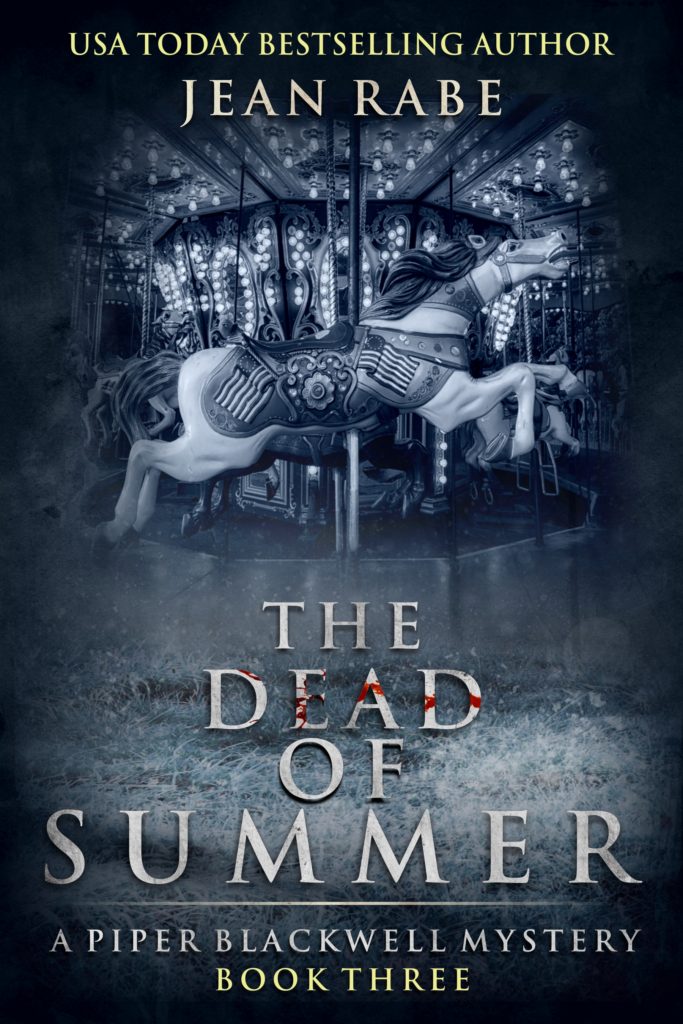
The Dead of Jerusalem Ridge, the latest and fourth in Jean Rabe’s excellent Piper Blackwell mystery series, is not only a worthy companion to the first three; it may well be the best one yet. Although, I am loath to say that, for how do you judge among four outstanding entries in what amounts to the chronicle of twenty-three-year-old Piper’s first eight-and-a-half months on the job as the sheriff of Spencer County, Indiana. The first in the series, The Dead of Winter, begins on January one, Piper’s first day on the job, and the day starts with a murder. A left-over Christmas murder. Not joy-to-the-world, but certainly joy-to-mystery fans.
Sheriff Piper Blackwell had been elected to the office in a race against her sixty-five-year-old vastly experienced Chief Deputy, Oren Rosenberg. Oren is not particularly magnanimous in defeat, but he is a professional and conducts himself appropriately. Piper only ran for the office at the behest of the former sheriff, Paul Piper, her father, who had to step down to fight cancer. A fight he was expected to lose. Piper, an Army MP, decides not to reenlist comes home from Iraq to be with her father. To make him happy, she runs in the election to replace him, expecting to lose. Who the hell would vote for a twenty-three-year-old “girl” to be the sheriff? She didn’t lose. Shocked that she won, she could only believe that the voters had assumed the “Blackwell” on the ballot was her dad. She starts the job young, relatively inexperienced, deeply insecure, and convinced she is a fraud. And there’s a murder on her first day. If there’s a list of the best fraught-with-potential beginnings for a mystery novel series, I would like to add the Piper Blackwell Mysteries to it.

As the series continues, Paul Blackwell survives his cancer, regains his health, and becomes the Chief of Police of Santa Claus—not the red-suited Ho-Ho-Ho myth but the largest town in Spencer County. Oren Rosenberg remains resentful of working for sheriff no older than his granddaughter while never being less than a valuable asset to Piper’s department. More characters are introduced and become regulars. Detective Basil Meredith, late of Chicago P.D., who brings his urban mean streets-forged smarts to rural Spencer county. Dispatcher Zeek the Geek, an eighteen-year-old computer whiz. And Nang, the Vietnamese-American owner of a gas station/Quick Mart and excellent chef serving fine Vietnamese cuisine at his gas station/Quick Mart. Nang becomes Piper’s romantic partner—and the best chance for her to eat nutritiously.
Rabe takes all these elements and forges them into the prose art of presenting people, place, and plot in proper measures to transport the reader into the minds and concerns of her characters; onto the ground of Spencer County, Indiana and closely surrounding countries and states; and on a trip from incident to incident making up the “what” of the story and the “why” of the plot.
None of the people, Rabe’s main characters, are either archetypes or stereotypes, but individuals the reader is happy to get to know. They have their good days and their bad. They have insecurities mixed with confidence. They love, get irritated, enjoy food and relationships. They are Midwesterners and middle-class, and yet not stuck in some middle-of-the-road sameness, They each have their quirks. Don’t we all? Which is why we can relate to them. Most importantly, they are all fundamentally good people. Except for the murderers, of course.
Through Rabe’s clear powers of description, the place where her people dwell becomes ground upon which readers can solidly plant their feet. It is not a glamorous territory, or a dark and dangerous one, but it is also never mundane. It’s real, and the reader takes it for what it is—a place where people live, love, and try to do their best for themselves and others.
As to the plot of The Dead of Jerusalem Ridge, I will not summarize it here. I hate summarizing plots. Ray Bradbury once told me that people don’t read a book just for the plot, but for the asides, which reveal truths about the people and places in the book. I think he was saying that the essential part of a story is its soul and not its bones. Not that the bones are insignificant, just that they are there to serve the deeper meanings of Who and Why. I know this seems antithetical when it comes to a mystery novel, and you are welcome to disagree. But as for me, I have never read a mystery for the plot. I’ve always been most attracted to the characters and their landscapes, both exterior and interior.
Jean Rabe gives great characters and landscapes. 
Jean Rabe
Oh, and by the way, The Dead of Jerusalem Ridge has a damn fine mystery plot. Just in case you were wondering.
______________________________________________________
Check out Jean Rabe’s Piper Blackwell Mysteries on Amazon HERE.
Find her webpage HERE.
You can check out my novels on the MY BOOKS page HERE