Showing posts with label authors. Show all posts

Saturday, March 30, 2024

ONLY AUTHORS SHOULD BE AUTHORITARIANS


DICTATORS OF THEIR OWN WORLDS


There is a lot of talk, buzz, worry, concern, hand-wringing, and general if, for the moment, gentle panic about the ugly heads of authoritarians rearing up everywhere. 


Gentle panic? 


I just wrote it, and I’m not sure I know what it means. Maybe it’s the kind of panic where you are not yet screaming and running out the door, but you are holding your breath and hoping to hell you will be able to breathe easy sometime sooner than not. 


This is a worldwide condition. Or at least in those countries governed by some form of democracy. But even in democracies, some would seem to prefer a strong, unbound hand at the tiller of state. As I said in my Old Curmudgeon’s Book of Questions video on YouTube fourteen years ago, 


“If we all agree that democracy is the best form of government then why is it people are so quick to support a dictator—if they agree with him?”


In thinking about this recently, I realized that my concerns about authoritarian dictators running things (usually into the ground) have found their way into many of my novels. That’s certainly true of my latest release from Magpie Press, IMP: A Political Fantasia. 


"Steven Paul Leiva is a very bad man. His version of U.S. politics Trumps anything the real world has to offer. Hell, you thought the orange one was the only homunculus America had to worry about? You thought wrong. There's always the nuclear option." — Steven Savile, New York Times & USA Today Bestselling Author. 


It’s the story of an accidental president of the United States who suffers from wanting everyone to toe the restricted line of his personal view of what constitutes true virtue and proper morals. My model for this short novel was Dickens’ A Christmas Carol, wherein a stubborn miser is shown the error of his ways via visitations from some fantastic entities. Several ghosts, in Dickens’ case. 


In my case, one annoying little imp who often dresses just like the president. 


The imp crawls out of the president’s ear and begins to wax, if not elegantly, then quite surreally. Both stories are infused with the comfort of hope for redemption, as unlikely as that may be in reality. But then, this is why both books are fantasies. 
 

Two of my early novels, The Fixxer Adventures, Blood is Pretty, and Hollywood is an All-Volunteer Army, are ostensibly thrillers and satires of Hollywood, where I spent an inordinate amount of time in my innocent youth. But their antagonists are men and women who wish to have power over people, possibly for profit, possibly for ego, or possibly just for the thrill. 


"Steven Leiva not only promises but delivers.

Beautifully written. Bravo!" — Ray Bradbury.


In Blood Is Pretty, the bad guy that my hero, The Fixxer, must thwart is a film executive, Andy Rand, who chases after a virtual reality program more powerful and effective than the ones we have today. Veritas is its name, and it can quite literally control minds and give them whatever “truth” the controller wishes to give them.  That film executives enjoy having power over people’s lives in Hollywood is not, I think, a surprising idea. So why wouldn’t they want power over people outside of Hollywood if they could grab it? Is it a personality type? Or a drug hard to kick—until they are kicked out. 

"Leiva's immense gifts for mystery and suspense
are matched only by his wry, biting wit in skewering
the Hollywood he clearly knows so well."

— Paul Provenza, author of ¡Satiristas!, director of The Aristocrats,


In Hollywood is an All-Volunteer Army, The Fixxer must deal with a cabal of up-and-coming Hollywood executives under the sway of the mysterious ex-gunrunner Maxwellton James and prominent film executive Sara Hutton, the child of a famous clown. Max and Sara are plotting to develop an “army” of film executives. They will be groomed to launch through the media that they will eventually control a propaganda campaign to beat back the coming wave of Have-Nots from the Southern Hemisphere, who are coming up to pollute the Northern Hemisphere, the natural abode of the Haves. They must be stopped! Sound familiar? I wrote Hollywood is an All-Volunteer Army in the late 1990s, but it was obvious to me that some people worldwide would love to “build a wall” at their southern borders to keep themselves “pure.” It is, of course, an unrealistic task. But that doesn’t stop them from trying or giving power over to the worst people who promise to fulfill their dreams.


My science fiction satire Traveling in Space is a first-contact novel written from the aliens' point of view. 


"Traveling in Space's humor and refreshing
perspective 
is thoroughly enjoyable"
— Diane Ackerman, New York Times bestselling author of
 The Zookeeper's Wife and A Natural History of the Senses.


One day, these alien explorers and scientists stumble across the earth. As they had always believed that they were the only life in the universe, they are understandably surprised. And some of them are not a little annoyed. Some vote to move on and try to forget this mote of dust, crawling with primitive creatures. They neither want the Earth’s water nor its women nor do they want to uplift the denizens of Earth to some angel-like state of wonderfulness. Let them do that on their own if they can. But being explorers and scientists, most of the aliens feel compelled to look closely at our planet and us, the odd characters that populate it. Authoritarianism becomes an issue when the aliens' leader—known quite logically as “Our Leader”— colludes with the President of the United States in a truly awful endeavor, but one that they believe will turn Earth into a true paradise and a lovely planet to have authority over. Do they succeed? You will find out when you get to the end of the novel. 
 
My recent novel, The Definition of Luck or The Post-Modern Prometheus, is a contrarian science fiction novel that takes a skeptical look at the potential of mind or consciousness uploading to a non-biological platform. 


"I thoroughly enjoyed The Definition of Luck."
— Stephen Webb, Physicist, Author of
New Light Through Old Windows: Exploring Contemporary Science
Through 12 Classic Science Fiction Tales.


Whereas much of science fiction takes a non-skeptical, even giddy, assumption that it’s just around the corner. A true shuffling off our mortal coils, releasing our newly immortal minds to dance among the digital ONES and ZEROS. Which, of course, has nothing to do with authoritarianism. However, an issue in the novel revolves around the political situation in Kenya of the near future, which has had a problematic relationship with democracy. But the father of one of my protagonists is a staunch democrat and fights for democracy, even while realizing that it is not always a perfect system. He tells his son, “The greatest asset of democracy is the demos. But then, the greatest liability of democracy is the demos. That son, is the paradox of democracy.”


In Journey to Where, which I call a Contemporary Scientific Romance, having been inspired by the novels by H.G. Wells and Jules Verne, authoritarianism is plainly in view. 


"A deftly crafted, inherently interesting, and thoroughly

entertaining read from cover to cover…

unreservedly recommended,”

— Midwest Book Review


Due to a sabotaged experiment into a sought-after element of time, a group of scientists finds themselves on an Earth where sixty-six million years ago, a meteor did not strike the planet, leading to the extinction of the dinosaurs and the rise of mammals. So, two dinosaur species evolved after millions of years into bipedal, intelligent creatures rather than mammals doing so. Our scientists find themselves in a world that was once far advanced from our own—these dinos had a hell of a head start. But now that world has fallen into a dark age ruled by a big fist, which hoards not only the land’s riches, controlling a class system of Haves and Have-Nots, but any knowledge his struggling scholars manage to discover. Including these strange scaleless and downy-less creatures that have wandered into the land of Anaraquan. Which translates as Where the Great Quan Rules. The scientists' dilemma is whether to, as they say, go along to get along or fight against the Quan, who rules them all.


Creature Feature: A Horrid Comedy was built on the question, where do the creatures of horror books and films come from? 


"CREATURE FEATURE is a weird, funny, twisty romp through
the creepier parts of the American landscape.
Highly entertaining and highly recommended."
— Jonathan Maberry, NY Times Bestselling
Author of ROT & RUIN and V-WARS


Why do ordinary and sensible people create such characters as cobbled-together monsters, wolfmen, vampires, giant gorillas, giant two-legged lizards, gelatinous blobs, and zombies who most definitely do not exist in the real world and, unlike creatures of ancient mythologies, are not trying to explain natural phenomena?  I figured I could get some humor from that, and many readers have told me I succeeded. But, of course, I couldn’t leave well enough alone and had to make the novel a political satire as well. For the creatures that feature in my book, led by a demon of a decidedly authoritarian bent, decide not to stomp and tramp and tear down and fire-breath our world—but to form a political party!
 
I have always felt that if there were justice in the world, the only true authoritarians that should exist are me and my kind—authors. We create worlds and characters and can do with them as we wish. It’s quite god-like and usually hurts no one, nor prevent other people from being happy. Unless they don’t like your work, but that’s hardly life-threatening. But such god-like powers in the hands of one or a few flesh-and-blood humans over a mass of other flesh-and-blood humans have rarely led to good times for all. Even if you think you agree with a dictator, there is always the chance that he or she won’t agree with you. Then—watch out!
-----------------------


You can check out all of my books on the MY BOOKS page on this blog. Or you can go directly to my Author's Page on Amazon.

Cheers, Everyone!


The Grand and Exalted Leiva.
 Dictator Over His Imaginary Worlds.


Tuesday, May 11, 2021

A NUMBER OF REALLY NICE AUTHOR THINGS


Hello, Everybody!


It’s starting out to be a nice week for this author


NICE THING # 1


It’s a wonderful thing to be endorsed by a master!


Phil Proctor of The Firesign Theater has offered this blurb for the Audiobook edition of CREATURE FEATURE: A HORRID COMEDY. 


“This is the most horrible thing I’ve ever heard — and that’s a good thing! It’s screamingly funny and probably one of the best performed and produced audiobooks I’ve ever heard...and I have tinnitus." ~ Phil Proctor of the Firesign Theatre


As you may know “Entertainment Weekly” ranked The Firesign Theater among the “Thirty Greatest Comedy Acts of All Time.” And the US Library of Congress, when adding their album “Don’t Crush That Dwarf, Hand Me the Pliers” to the National Recording Registry, they called the group “The Beatles of comedy.”


The Firesign Theater then

Phil Proctor today


As the author of the novel, I’m honored and delighted. But Phil Proctor’s words are truly a testament to the wonderful work Seamus Dever did as the producer, director, and editor of the audiobook. And his and Juliana Dever’s performances in bringing the book to ears all around the world! Along with the original music by Ray Zeigler, they have created something much more textured and fine than a simple reading of the work. My cheers—and love—to them.


Juliana Dever

Seamus Dever

Ray Zeigler


NICE THING # 2


I'm thrilled to get the first AMAZON 5-star review for BULLY 4 LOVE within a week from launch.

============================================

Katinka

5.0 out of 5 stars

Mom Kat Reads

Reviewed in the United States on May 9, 2021

Adolphus didn't know it, but his life would be forever changed when a woman named Livinia walked into his Adult Education class. The changes wouldn't come directly from or through her, though something about her presence seemed to bring about great change in those whose lives she touched.

This was an unusual story. In the beginning, I wasn't sure what to make of it. It's isn't your typical romance story. (Livinia is a very happily married woman, and there is no physical, romantic, or emotional relationship between Adolphus & Livinia.) This book more truly explores the story of Adolphus & Livinia's husband Eugene.

But again, it is not a physical or romantic love story between these two men, but more a story of how their lives intertwined throughout the years. The two had known each other as children, and while in the beginning they seemed destined to destroy one another's futures, instead it turns out that they are meant to be each other's saviors.

I really enjoyed reading this story. It brings you through the full range of human relationships. This book at times made me laugh and at other times made me cry. This is a contemporary tale that you really won't want to miss.

Highly recommended for anyone who enjoys reading deeply personal stories about how the simplest of things can be the catalyst to forever alter the course of someone's life.

==========================


NICE THING # 3


It was my distinct pleasure to be interviewed by Patricia Bates on her podcast DISTINCT AUTHORS TALK PUBLISHING.


Patricia Bates


And we did talk about publishing, but also the art of writing of prose, which I find much more interesting. You can listen to the podcast on Spotify here:

https://open.spotify.com/episode/0qJCtPAAU8jb5jEgaqQxL5 


As always, all my books can be purchased on Amazon, and you can see them all on my Amazon Author's Page right HERE.


AND ON A PERSONAL NOTE


I will be ending the week celebrating at the Bowers Museum in Santa Ana the birthdays of my two daughters—Miranda (April 27) and Nanette (June 5)— and their old man whose birthday comes somewhere in between. We are taking the opportunity of the Disney Archives Exhibit at the museum to gather all together for the first time since the pandemic started. We will be joined by Nanette’s husband, Rick, Miranda’s best friend, Selena, and my lovely wife, Amanda.


Don’t know what the hell I’m going to do next week! 


Friday, March 25, 2011

Six Characters in Search of a Stenographer

If you are at all interested in novels and novelists you have probably read an article about, or interview with, one of your favorite authors in which the author declares: “I don’t really write my books, my characters write my books, they talk to me and I just take dictation.” Readers seem to love hearing this from novelists, if we take as evidence the fact that so many fictioneers, not to mention a few literary authors, have spouted this line at least once in their careers. It is a statement that portrays the writing process as almost mystical, practically magical and downright mythic, putting writers and their process on an existential plain somewhat above the mundane. Some authors will use the qualifier as if, but I think many reader’s eyes glaze over those two simple words and accept only the unqualified version.


It is, of course, an absurd notion and a damn silly thing to say. After all, Pirandello did not write Six Characters in Search of a Stenographer. Writers write their own work, it comes from them and not from some rarified literary ether where characters live. Writers deserve all the credit for what they produce—or all the blame.


This stenographer-author notion may come from the fact that when you are writing well, when the words are just flowing out almost faster than you can write them down, it does indeed feel as if something supernatural is going on, but this is more akin to the art of a good jazz musician or improvisational comic, than to the channeling of a psychic. Everything that a jazz musician, or a comic as wildly inventive as Robin Williams, does comes not from somewhere out there, but from somewhere in their brains—and only from their brains. Brains that we hope have been well-informed and that are the repositories of a myriad of experiences both personal and researched, as well as knowledge and opinions lodged in those brains and based on the information received and the experiences deposited. Add to this the emotions naturally attending this information and knowledge and those experiences, and you have a very real place from which music, comedy—and certainly novels—can spring.


Good writers do not channel in from some higher plain, they are simply human creatures who have a talent for expression and a talent, as Noel Coward would have said, to amuse. Brilliant writers combine those talents with a talent to reveal truths—or, at least, very interesting questions—about the human condition. Everything they write—everything—is an expression of their selfs, no other selfs are involved.


I started thinking about all this a couple of weeks ago after I went to the Hammer Museum in Westwood to attend the screening of two works of Samuel Becket’s that was part of the UCLA Festival of Preservation. One was the 1961 television production of Waiting for Godot with Zero Mostel and Burgess Meredith.


Al Hirschfeld's drawing of Burgess Meredith and Zero Mostel in Waiting for Godot


The other was the only film Becket was involved in, an experimental short made in 1965 called Film, featuring Buster Keaton. 


Buster Keaton in Samuel Beckett's Film


Despite being considered by some the greatest playwright of the Twentieth Century, Beckett, being avant-garde and absurdist, is not an easy writer to warm up to, although I do think his Godot may be the greatest play of the Twentieth Century, or, at least, the purest distillation of the existential nature of man in the Twentieth Century. I bring Beckett up though, not to talk about him and his place in literature, but to offer an example of how an experience I had lodged in my brain and, many years later, came out in a short scene in my Hollywood based thriller, Blood is Pretty:The First Fixxer Adventure.


In 1979 I was an independent publicist specializing in small animation studios. One of my clients was the great Chuck Jones who had been one of the key directors of the Warner Bros Looney Tune shorts. 


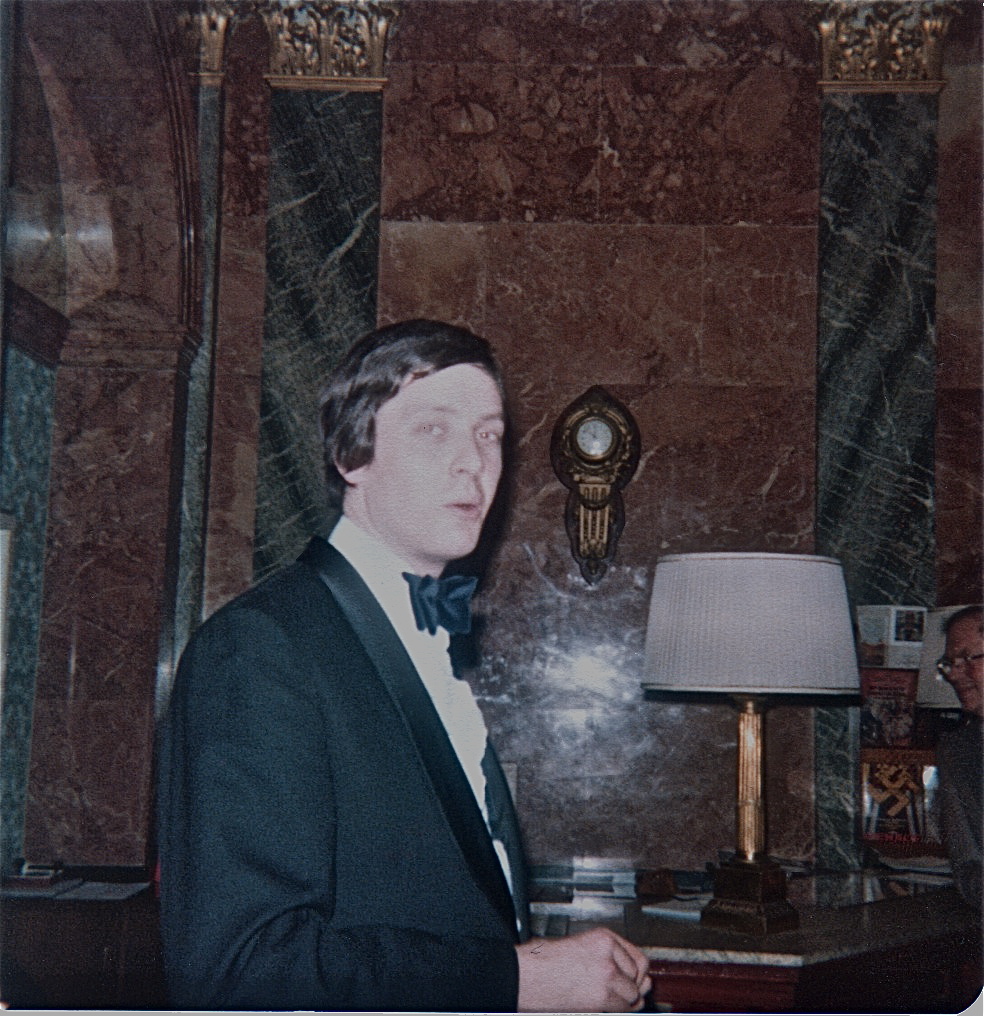
Me at the servants entrance to the Chuck Jones Studio in Hollywood. Photo by Peter Lonsdale


We were in London, where Chuck was having a “season” at the National Film Theater, and staying at the Hyde Park Hotel in Knightsbridge. 


The Hyde Park Hotel seen from Hyde Park
One afternoon when we came back from a radio interview Chuck had done, the hotel’s Major Domo, the tall, handsome and very efficient Peter Crome, excitedly informed us that, “Mr Samuel Beckett is staying with us while he is in town doing several BBC Radio plays.” 


Peter Crome at the Hyde Park Hotel in 1979, later voted one of the top three Hotel General Managers in the World in a readers poll in Gallivanter's Guide. Chuck Jones can be see to far left of the photo.
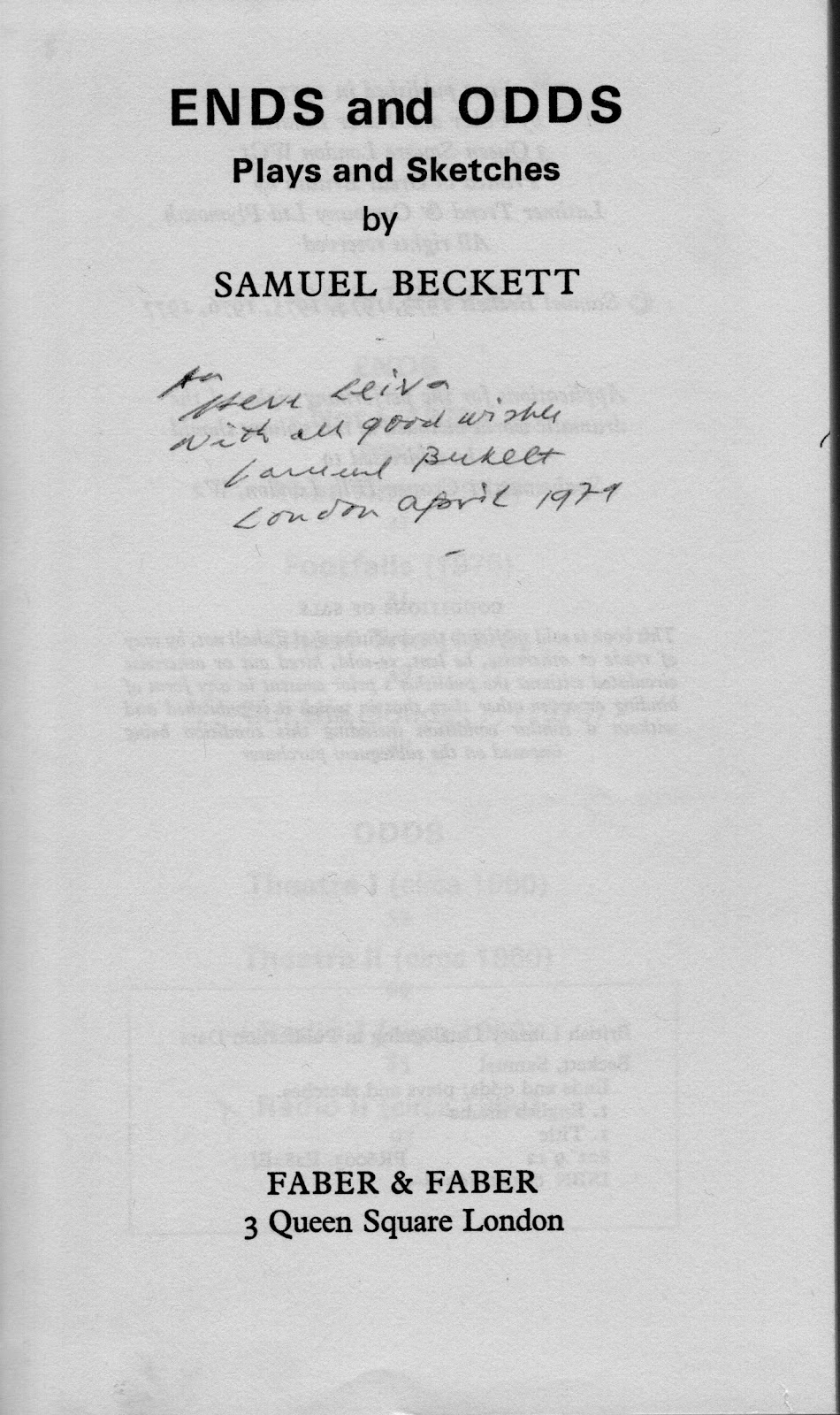
Chuck did not seem impressed, but then Chuck was not often impressed with a person until he had been convince that that person had been impressed by him. I, on the other hand, being a budding cultural snob (and here I was doing publicity for a man who had gained fame for animating a duck and a bunny!), was very impressed and shared Peter Crome’s excitement. While Chuck excused himself and headed up to his room for his afternoon nap, I asked Peter if he thought Mr. Beckett would autograph a book of his plays for me. Peter assured me that he could arrange it if I would but give him a copy of the book to hand to Mr. Beckett. I immediately left the hotel, went to the Knighsbridge tube station, took the subway to the Tottenham Court Road, emerged to quickly walk down Charring Cross Road to the big Foyles bookshop there and found Ends and Odds, a small book of plays and sketches by Beckett. I got back to the hotel and gave the book to Peter, thanking him for his kindness.


The next day when Chuck and I returned from another interview, Chuck went immediately up to his room to rest and Peter Crome called me over and handed me Ends and Odds, autographed by Samuel Becket. 


The thing itself


 I was thrilled and decided to go into the hotel bar for a drink to savor this, the first autographed book by a famous author I had ever received. I sat down and ordered a Pimm’s Cup, an alcoholic concoction Chuck had introduced me to and which I insisted on drinking despite not really liking because it was so English and I was, as I said, a budding cultural snob.


I started to look through Ends and Odds—I had not had time the day before to peruse it—and was fascinated to see that in Beckett’s Radio II radio play, the lead character was named, “Animator.” Wow, I thought as I looked up from the book. “Wow,” I probably said out loud when I realized that Samuel Becket was sitting alone across the bar directly opposite me drinking a beer. 


The man himself


I immediately got up and went over to him, apologized for disturbing him, but explained that I was the person who he autographed this book for, and I just wanted to thank him. He graciously accepted my thanks. I then told him that I was in London with Mr. Chuck Jones, the famous American animator and cartoon director and I couldn’t help notice that one of his characters in Radio II was called “Animator” and I was just wondering if the character was a cartoon animator? Mr. Samuel Beckett looked up at me as if I was an idiot—although the qualifier, as if, is probably unnecessary here. “No, no,” he said. “By ‘Animator’ I mean the one who animates the discussion.” “Oh,” I said, quickly excusing myself and going back to my Pimm’s Cup.


Peter Crome, Chuck Jones, Chuck's future wife, Marian Dern, and the young idiot in front of the Hyde Park Hotel
As time went on, and after actually having read plays by Samuel Beckett and seen productions of his work, this small, autographed copy of Ends and Odds became a proud possession and meeting Becket became a cherished memory. It should not be surprising, then, that years later when I was writing a scene in Blood is Pretty, involving my hero, the Fixxer (you never learn his real name), and his “Watson,” Roee (who is also an avant-garde playwright) the experience of meeting Beckett popped out of my head and became the basis for the following dialog between my characters:


     “Penne with Moroccan lamb and mint.”
      I opened my eyes. It was Roee announcing the “simple” pasta dish he had prepared for dinner. “Did the lamb really come from Morocco?”
     “It’s not the lamb that’s Moroccan, it’s the sauce. Which should include Zucchini, but as I know how much you hate Zucchini....”
     “Your indulgence of my dislikes is appreciated.”
     “And I know you are not a wine lover, but I have found a rather nice Chenin Blanc that I would deem it a tragedy for you to pass up.”
     “Well, if you can indulge my dislikes I can certainly indulge your likes. I will have a glass. And after dinner I would like you to join me for a little job.”
     “Oh.” Disappointment expelled with the word.
     “You had plans?”
     “I was going to watch a video tape of Waiting for Godot.”
     “Can it wait?”
     “I have borrowed it from a friend.”
     “Can he wait?”
     “It is Beckett directing Beckett!”
     “Well, he’s dead. I suppose waiting is not a problem for him.”
     “Fine. I will wait.”
     Roee began to leave as a commentary on my request.
     “I met Beckett once.”
     Roee turned back to face me, as I knew he would. “You did not!”
     “In the bar of the Hyde Park Hotel in London. He autographed a book for me.”
     “Which you have conveniently lost.”
     “No. You’ll find it in the Bs.”
     Roee went over to a bookcase. “Which one?”
     “Small blue book. Ends and Odds, I believe.”
     Roee pulled the book out and opened it up. His eyes widened slightly. “With your background, this could be a forgery.”
     “Yes, but for what reason? The only person it has ever impressed is you.”
     Roee looked at me, raised his eyebrows, nodded his head, and closed the book. “Let’s have dinner.”
     “Good idea. I’m starving.”


I can assure you that Samuel Becket did not look upon the Fixxer as an idiot. They probably had a wonderful, intelligent conversation, and most likely many laughs as Beckett drank his beer and the Fixxer drank his vodka tonic with a lemon twist (I can’t imagine the Fixxer drinking a Pimm’s Cup—therefore he never will!). However, if it had not been for that young idiot, who has become, I hope, less idiotic with time, my character would not have been able to reveal this little moment in his past, which I hope the reader finds to be an intriguing hint into the nature and history of the mysterious Fixxer.


My Fixxer novels, Blood is Pretty and Hollywood is an All-Volunteer Army, are available at Amazon.com. Check them out, sample them in digital print for your e-readers and, for Blood is Pretty, in audio as well.