Showing posts with label Hollywood. Show all posts

Thursday, May 18, 2023

DISPATCHING YOUR ENEMIES


While visiting Ray Bradbury in his home one day, he turned to me and asked, “Do you know what the great thing is about writing fiction?”


Ray Bradbury at home
“What?” I queried back.

“You get to kill your enemies!”

We shared a laugh over that because it can be so true.


Ray famously dispatched film director John Huston in his short story “Banshee.” Before he knew him, Huston had been one of Ray’s heroes. But when Ray worked with Huston on Moby Dick, writing the screenplay in Ireland, where Huston lived, Ray found him to be a merciless bully. 


John Huston and Ray Bradbury working on Moby Dick


It was a trying and possibly traumatic time for Ray. Which must have sat in his mind waiting for some kind of exorcism. Possibly it came when, years later, Ray wrote his short story "Banshee."


In “Banshee,” Huston becomes film director “John Hampton,” and Ray, whose middle name was Douglas, becomes young screenwriter “Douglas Rogers.” 


Charles Martin Smith as "Douglas Rogers"
and Peter O'Toole as "John Hampton"
in the Ray Bradbury Theater presentation of Banshee

It is blatantly autobiographical—except for the Banshee, of course, which is portrayed as an actual entity, and, horrifyingly, snatches Hampton off into eternity. 


Despite taking place in Ireland, “Banshee,” and Ray’s experience that gave birth to it, is a Hollywood story. It’s a wonder that Ray still pursued an association with “The Biz” after Ireland and the great white whale of Huston’s ego, but he did. Ray was a giddy cinephile. And, to be fair, he made many friends in Hollywood whom he admired and who admired him in return.


But it’s one's enemies who often provide the fodder for fiction.


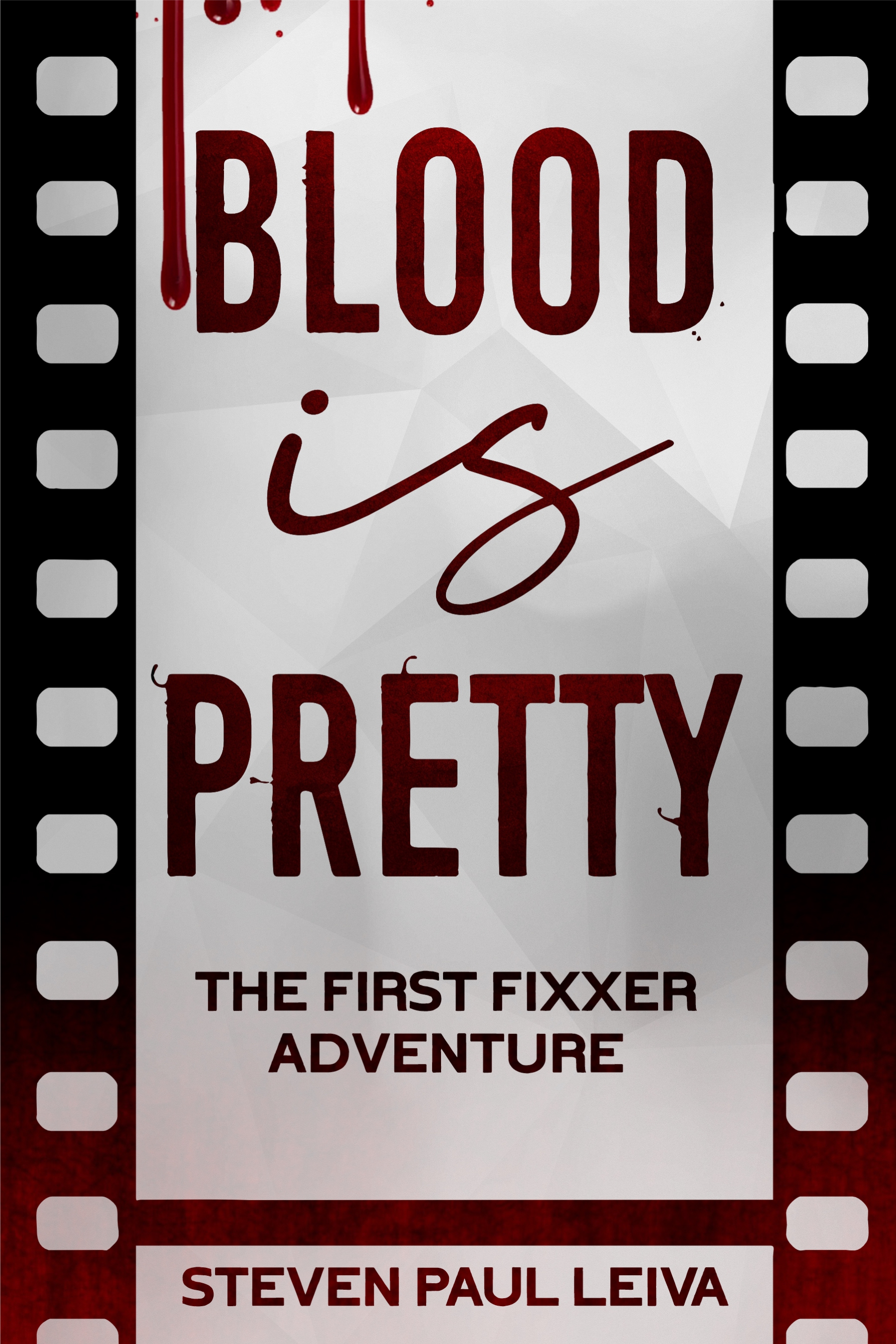
I discovered this while writing my critically acclaimed novel Blood is Pretty: The First Fixxer Adventure, which I have just re-published in a revised edition under my Magpie Press imprint. 


I wrote the novel in the mid-1990s after experiencing several painful “disappointments” in my Hollywood career. Disappointments in events and in people. Disappointments are not rare in Hollywood. And yet, when it is your disappointments, they seem far more intensely essential and worthy of revenge. 


I had intended for Blood is Pretty just to be a page-turning thriller inspired by such books from the past, including Ian Fleming’s James Bond novels, Sapper’s Bulldog Drummond books, and Leslie Charteris’ The Saint tomes. 


Fun to write, I assumed, and fun to read, I knew. But as it is not so much “write what you know” as it is, “what else can you really write but what you know?” the setting became Hollywood. And, since I had been a satirist since my college newspaper column writing days, I naturally took an askew (or screwy) view of the place and cast the book with people from my Hollywood past that I had found to be, shall we say, less than lovable.


So, I wrote a satiric Hollywood thriller—if you can imagine such a thing. But you don’t have to because I already did, and you can get it on Amazon as an eBook, trade paperback, or audiobook.


Did I have fun dispatching some of those less-than-lovely people? You damn right, I did. One was young and not yet famous but was convinced he would be before too long. And, indeed, he did become famous. One was an active director of mediocre movies who was self-deluded into thinking that all his films were fabulous. Another was a Hollywood hanger-on, a particularly obnoxious film reviewer for complimentary newspapers. And finally, there was a prominent studio executive whom I knew solely through press accounts in the Trades. But I did have a meeting with him shortly after Blood is Pretty was written. Irony—it's my life!


But lest you think Blood is Pretty is just an exercise in vindictive jollies, let me assure you I am not so one-dimensional and have a broader “what else can you really write but what you know?” field of dreams.


During this time, I read a lot about the brain and the scientific search for how it works. I have always been fascinated by how easily the brain is fooled. By dreams, by shadows, by shapes we perceive which aren't truly there. And, especially by our reactions to movies, how we can suspend disbelief and live comfortably in a manufactured reality. So I read books by Francis Crick, Paul M. Churchland, and Daniel C. Dennett and had the brain and its workings very much on my mind when I started writing Blood is Pretty.


This led me to create a McGuffin for my thriller called Veritas. This computer program can fool your brain far more powerfully than any virtual reality existing at the time and, indeed, even today. But it was also more than a McGuffin, for its existence in the story let me explore the gullible nature of the brain and how Hollywood exploits that.


The following paragraph is on the acknowledgments page of Blood is Pretty.


There is a particular theory of consciousness—of how the brain gives us reality—which I have used as a basis for a significant element in this novel. As reported in the New York Times, the theory’s strongest proponent is Dr. Rodolfo Llinás, a professor of neuroscience at New York University. I am indebted to him and the excellent New York Times science reporting for the inspiration. However, the technological extrapolation I spin-off this theory comes solely from the reality of my brain, and neither Dr. Llinás nor the New York Times should be held accountable for it.


Despite this modicum of serious intent in Blood is Pretty, readers have found the book fun, entertaining, and—I say with a modicum of humility—a good read. Now that I have re-proofed and polished the original book, I believe the new, revised edition is an even better "good read" than before.


XX


BLOOD IS PRETTY

THE FIRST FIXXER ADVENTURE


It's the late 1990s—and Hollywood wants to take over the world!


What those in the know in Hollywood really know is that if they need a dark deed done, if they need a sticky personal or professional problem "fixed," they can call upon the mysterious and dangerous Fixxer. With wit and aplomb, he works the fruitful fields of Hollywood, fixing the sins and correcting the stupidities of the denizens therein. 


In Blood is Pretty, The Fixxer comes to the rescue of “the most beautiful woman I have ever seen” to extricate her from the grip of the soul-sucking sexual desires of a producer born in slime and takes on the task of buying off with money and muscle a film geek who won’t cooperate with a director of minuscule talent who simply wants to claim “V”—the geek’s “Holy Grail” of a film treatment—as his own. When the film geek is discovered dismembered, the Fixxer is compelled to know why and finds worlds of evil, both real and virtual, centering around a computer program called Veritas, which has the potential of making its owner the wealthiest and most powerful human on Earth. With the aid of Roee, his friend, companion, and cook who can kill quickly and silently in several different ways; the Captain, officially with the Los Angeles Police Department, unofficially with the Fixxer; Petey, extraordinarily brilliant and comically strange; and “the most beautiful woman I have ever seen,” the Fixxer goes forth to do battle. 


Blood is Pretty: The First Fixxer Adventure (Revised Edition) from Magpie Press is now available in trade paperback and eBook formats on Amazon. You can also get the Crossroad Press audiobook edition on Amazon and Audible.


Cheers to all!


xx


Wednesday, May 26, 2021

What I Would Put On My Wikipedia Page If I Thought Wikipedia Would Let Me


Steven Paul Leiva is an American novelist who once led a secret life in Hollywood. He was born at The Woman's Hospital in Pasadena, California, on May 26, 1949, shortly before noon. It was just like him to show up for lunch. Soon after his birth, they razed The Woman's Hospital and put a parking lot in its place. It's never been firmly established if the two events were related.

At the age of three and a half, Leiva's family moved to the city of Azusa, just east of Pasadena, where he grew up. The city's motto was "Everything from A to Z in the USA." The motto was not wholly accurate.

Levia attended Azusa High School, a well-funded school due to the taxes paid by businesses in Azusa that brewed beer, concocted friction proofing, and built rockets. It's never been firmly established if the three were related.

While attending Azusa High, Leiva fell in with the wrong crowd—the Drama Department and its Aztec Players troupe of actors. Leiva loved acting. But upon graduation, he discovered that he wasn't six feet tall (as his mother had always promised he would be). And so, traveling under the false assumption that all actors had to be six feet tall, Leiva gave up the idea of acting and decided to write instead. He figured you didn't need to be tall to write.

Right out of high school, as the war in Vietnam was heating up, Leiva enlisted in the Air Force as a way to avoid the draft. It was a counterintuitive idea, if not downright ironic. However, after a career of twenty-two days, Leiva was discharged due to a discharge from a cyst in a sensitive place. It wasn't quite as glamorous as moving to Canada, but it did the trick.

Back home, Leiva enrolled in the local community college (then, embarrassingly known as a junior college) to see if he could learn a thing or two. Some colleges are named after great men or women or the major urban area they are located in. His college was named after fruit. Nevertheless, Leiva did learn a thing or two at Citrus College, and was grateful to do so.

From Citrus College, Leiva left Azusa to continue his fruity education in Orange County. He entered the hollow halls of a state college (later, it grew up and became a state university). He soon left those hollow halls when he found himself unable to suppress chuckling at professors who professed that they were not living a pristine, un-real-world Ivory Tower existence because they actually drove to work on the freeway. (yes, Leiva didn't get it, either). There was also the fact that he was now married with his first child. So he left the college summa come-to-poppa and entered the world of retail (which is most definitely not an ivory tower existence).

Leiva became a major appliance salesman of very little talent. He was happy to help people purchase appliances they wanted but had an aversion to talking them into refrigerators and stoves they didn't want—silly him.

Leiva consoled himself by writing short stories. He found—as he suspected he would—that the landscaping of blank pages with little black letters forming words forming sentences forming paragraphs forming characters, ideas, causes & effects was not only fun but possibly nourishing. So he left retail.

Or, to be honest, retail left him. Much like his marriage had a few months before.

Set adrift in a no-income real world with nary an ivory tower to be found, Leiva scanned the Help Wanted pages of the Los Angeles Times. His eyes fell eagerly onto HELP WANTED: ADVERTISING SALESMAN FOR AN ARTS MAGAZINE. YOUR INTEREST IN THE ARTS MORE IMPORTANT THAN YOUR ABILITY TO SELL.

Perfect! As Leiva had a deep interest in the arts and absolutely no ability to sell.

Leiva went in for an interview and learned that it was a commission-only job. He was disappointed. There was something about a counted-upon paycheck that he had grown accustomed to. However, the editor of the magazine, a perfectly lovely man who unfortunately dressed like a pimp, having been informed of the circumstances of Leiva's separation from his last job, told Leiva to file for unemployment. "Around here, we call unemployment, government support of the arts."

And so Leiva filed for unemployment and strived to sell ad space in the magazine with little, or possibly minuscule, success. Still, the editor saw something in Leiva and gave him a shot at writing uncompensated articles and reviews for the magazine. Which was damn nice of him. Leiva happily landscaped some blank pages with pieces about art, creativity, beauty, and joy.

But there was a dark cloud on the horizon. It was called Hollywood. Not the photographic, flashy Hollywood of glamorous stars and larger-than-life producers and directors, and couches to cast upon, and craft services to get fat on. But the hand-drawn Hollywood of cartoons (sometimes thought of as animation—when they were thought of at all). It was a secret world of adherents and acolytes with code words and knowing nods. Leiva found himself recruited into a cartoon cult. There were strange initiation rites and hazing. He was forced at times to wear no pants, to stuff his five-fingered hands into four-fingered gloves, and to speak in a funny voice. Funny ha-ha and funny weird. There were cult leaders of one-syllable names, and enforcers who drew the line and demanded you always be on model.

Once again, Leiva consoled himself by landscaping blank pages with little black letters forming words forming sentences forming paragraphs forming characters, ideas, causes & effects. But this time, he was writing novels. As he suspected he would, he found that it was not only fun but possibly life-saving.
 
After nearly twenty years in the cartoon cult, Leiva rose to a high position and was given a "plum" mission. He was tasked to help facilitate the pairing of wacky, crazy, dare we say, looney cartoon illusions-of-life (anthropomorphic in the main) with fast dribbling, high jumping, and often sweaty, taller-than-normal actual-life. Ironically this afforded Leiva the opportunity to escape the cult when a tunnel formed between the worlds of the illusion-of-lifers and the actual-lifers.
 
He made his break, crawling as fast as he could through the tunnel, careful to avoid the monsters and creatures dwelling within. Once thought mythical, Leiva had discovered that they were all too real. With cunning and stealth, he slipped past the Flaming Egos (although he did get singed). Leiva slid unseen under the feet of the Prancing Primadonnas (boy, could they dance!). He managed to stay under the radar of the Tiny Meanie Caustic Clueless Executors (whose wild calls of NO! never stopped reverberating). And luckily Leiva was ignored by the Dark Digital Demons streaming en masse through the tunnel to the illusion-of-life land to suck the pencil lead out of the weak, defenseless cartoons and replace it with zeros and ones.

But Leiva didn't care. He broke out of the tunnel and into the sunshine, free! Free to be he and him!
 
Hand-in-hand with his second wife and second child and occasionally his visiting first child (all adored), Leiva found an open and vast world of blank pages. Beautiful blank pages he could landscape with little black letters forming words forming sentences forming paragraphs forming characters, ideas, causes & effects. Leiva was finally happy. It has been firmly established that the two events were related.

Leiva's landscaped landscapes, commonly known as novels, can be checked out HERE


FOLLOW ME ON

     FACEBOOK   TWITTER  YOUTUBE


Monday, May 23, 2016

BLOOD IS PRETTY EBOOK ON SALE FOR LIMITED TIME - ONLY 99 CENTS


Starting today and running until June 5 the eBook edition of my first Fixxer adventure, BLOOD IS PRETTY is going on sale for only 99 CENTS! When discussing dates for this sale period with my publisher, Handsome David Wilson of Crossroad Press, I picked these particular dates as they encompass my birthday (May 26) -- and I thought it would be a fine thing to offer a discount as sort of a party favor for all my friends out there in digital space -- AND the birthday of my dear darling daughter, Nanette (June 5), who has always been one of the best presents I have ever received.

So, join the party! Order your eBook now from Amazon for your Kindle or Kindle reader app.

And for those who are already fans of the book, thank’s for your support and please pass this onto on to your friends. Here are the links for the US and the UK where BLOOD IS PRETTY is on sale for 99 PENCE!

Amazon US: http://tinyurl.com/nmppdlg


Saturday, February 16, 2013

GIVE STEVEN PAUL LEIVA A GOOD SWIFT KICK IN HIS BOOKS WEEK


You’ve all heard of Kickstarter. This is where people with admirable projects -- a film, a new organic baby food, a portrait of President Obama created using only thumbtacks and used contact lenses -- and who need a little financial kick to get going, put their proposal online and ask friends and relatives and relative strangers to send them anywhere from a dollar or two or ten, to thousands of the digital greenbacks. And what do people get for doing so? Well, depending on the level of your contribution, you might get a “shout out” on a Facebook page, your name on the wall of a micro brewery, two tickets to a film yet to be made and maybe a character named after you, or the actual product (a neat tee shirt?) when it is finished. Kickstarter has become quite popular and newsworthy, and now it seems that everybody is doing it.

I was musing on this the other day and it occurred to me that I, the author of novels, don’t really need a kickstart -- novels are not expensive products to create. And I’ve never really had a problem in starting (or finishing) them. But having three novels I’m very proud of available for sale in various formats (print; e-book; audiobook) at that great supermarket in the Cloud, Amazon, what I need is not a kickstart. I need a bloody kick forward. You might even say I need a good swift kick in the books.

Why? Because it would be great to get boku sales of my books in a concentrated period of time in order to send up a flag of triumph to Amazon thereby possibly spurring them on to feature and market my work, which would, it is hoped, lead to more sales. Wouldn’t that be lovely?

So I drop all pretensions to decorum and audaciously presume upon all your good natures to help.

I’ve decided to declare the week of February 17 to 23 GIVE STEVEN PAUL LEIVA A GOOD SWIFT KICK IN HIS BOOKS WEEK. If you want to help that week -- buy one (or more, he hastened to add) of my books.

And just what is that going to cost me, Leiva?

Well, my e-books are priced at $2.99 and $3.99 -- cheaper than a Latte at Starbucks.
I have one book at the moment in print (more to come), and it’s only $14.99 -- cheaper than red lobster at the Red Lobster. And my one audiobook is under 20 bucks -- cheaper than a new pair of jeans at a discount fashion store.

(You can check out all my books, read reviews from people of distinction and readers of taste, see videos and listen to an audiobook excerpt at my new MY BOOKS page on my blog http://stevenpaulleivasthisnthat.blogspot.com/p/my-books.html.)

And for your “donation” what do you get? Well -- you get one of my books!! Hey, it’s like old-fashion 20th Century commerce, you give me money I give you the product. It’s very simple. Not a lot of cool, post-modern bells and whistles, but what the hell?

But I don’t have a Kindle, Leiva.

No Problem. You can download Free Kindle Reading Apps at Amazon. With these apt apps you can read my books in the Amazon Cloud Reader, on your smartphone, computer or tablet.

But I don’t want to read your books, Leiva.

Fine, I’m not asking you to read them, just buy them. That’s what’s so audacious about this proposal. Just buy it, download it, then trash it if you wish. You won’t even be wasting paper. Just think of it as buying me a discounted Latte at Starbucks so we can sit down and snicker at all the wannabe screenwriters sweating over their laptops.

But -- should you choose to read one of my books I’m pretty confident you’ll enjoy it. Others have. My Hollywood friends would enjoy my Hollywood satiric thrillers, "Blood is Pretty" and "Hollywood is an All-Volunteer Army." Although my Hollywood enemies might not. For those of you not employed in Hollywood, don’t let that put you off. I know you know enough about Hollywood to get it. Plus, who doesn’t like thrills? As to my sci-fi satire, "Traveling in Space," a sometimes comic look at humankind’s place in the universe: Are you a human? Are you in the Universe? Enough said.

Or buy me the equivalent of a cheap dinner and purchase the print edition of "Traveling in Space." You’ll get to hold a “real” book in your hands and get high smelling the ink. Or the audiobook of "Blood is Pretty." Take it on a long drive. You’ll enjoy Jonah Cummings’ fine reading.

If you ever wanted to give me a good swift kick in the butt -- and I’m sure several of you have -- now you can do it metaphorically by giving my books a good swift kick forward. So run (with your key-clicking digits) don’t walk to the MY BOOKS section of my blog (http://stevenpaulleivasthisnthat.blogspot.com/p/my-books.html) and check out my books. Then click on the Amazon links provided and -- check out my books. You will get the deep satisfaction of helping an author under six foot, but who tries to stand tall nonetheless, you will get literary value for your dollar, and you will get my undying gratitude.

And if this decorum-less and audacious invasion into your consciousness works and my books do indeed get kicked forward, I will be happy to tell each and everyone of you individually that you -- and you alone -- made me the success I will be tomorrow.

P.S. And go ahead, forward this on to friends and family; share this on Facebook; put up a billboard in the town square. Just how many people will you really alienate?

GIVE STEVEN PAUL LEIVA A GOOD SWIFT KICK IN HIS BOOKS WEEK FEBRUARY 17 TO 23

Friday, February 11, 2011

Nothing Personal, It’s Just Business: On the Amorality of Business

Out of many memorable exchanges of dialog from Francis Ford Coppola’s The Godfather this is probably the one that has had the most impact on society at large:  


Tom Hagen: Your father wouldn't want to hear this, Sonny. This is business not personal.
Sonny: They shoot my father and it's business, my ass!
Tom Hagen: Even shooting your father was business not personal, Sonny!


It's an exchange that has been condensed down to this handy, easy to spout statement: “Nothing personal, it’s just business.” 


A fellow traveler, so to speak, is this famous line from Oliver Stone’s Wall Street: “Greed is good.”  


I don’t know this for a fact, but I can guess that both Stone and Coppola meant their dialog to be condemnations, not celebrations of these attitudes. It is painfully ironic then that far too many members of the corporate business community seem to have taken these dialogs and turned them into mantras of Mammon’s own truth, which they are only too happy to chant -- although probably not while sitting cross-legged in simple robes. It is a “truth” that sets them free to do exactly as they like no matter the harm or consequences to others or to society.   


My fictional hero, the Fixxer, have given this matter some thought and reveals his thinking in my latest Fixxer Adventure, Hollywood is an All-Volunteer Army, which has just been published as an e-Book by Crossroad Press.  


Let me set the scene for you. The Fixxer has just been tortured by Pye, a London banker -- and I do not mean by going over arcane accounting procedures. A thug, at the order of the banker, has punched and slugged the Fixxer, and snapped his finger into his un-lidded eyeball, not to mention thrown his head into a blazing fireplace. The Fixxer has been rescued by Roee, his “Watson,” in the nick of time, and 


they are now back in the Fixxer’s room at the Hyde Park Hotel in the Kightsbridge section of London.
Roee has tended to Fixxer's wounds and put him to bed after forcing him to take a hot bath and, despite vodka tonic being the Fixxer’s normal drink, giving him three large slugs of Dewars. 


The intoxicating warmth was just beginning to spread out from my stomach, making me feel as if I could defy gravity. Must have been Roee’s intention. He wanted me to float off into dreamland. I was just beginning to like the idea, even the sense of vulnerability that came with it, when, in the middle of closing the drapes, Roee was stopped by a thought.


"I’m also wondering if there are not other things to learn here," he said.


"Such as?"


"Pye. If he’s this tough on competitors, what must he be like if you’re late on your credit card bill?"


"You think there’s something more there?"

 "I wouldn’t be surprised, but I can’t figure out what. The cover seems to have held. He was going to murder Elsworth Henderson, not the Fixxer. That much seems clear, but a banker murdering? After all, it’s just business."


I seemed to have been tethered to the ground. For suddenly, although still floating, I was yanked back, couldn’t go any higher. I was still high, but.... "He said that too."


"Who? Said what?


"'It’s just business.’" Pye said that when he was requesting our sources of financing. He said something about it not being like he was asking me to reveal something important, like, ‘state secrets.’ It was, ‘just business.’ You know, it occurs to me, Roee, that that’s probably the most pernicious phrase in the English language. It’s used to excuse so much, isn’t it?"


"Is it?"


"Of course it is. Roee, what binds society together?"


"Fixx, you need your sleep."


"Answer my question. What binds society together? What has always bound society together? At least for the last ten to twelve thousand years or so?"


"I don’t know. Common beliefs. Religion, on occasion."


"Roee, no disrespect to your own, but religion only binds the like-minded together. I mean all of society, all of society in the mundane, the real. Nothing exulted."


"A sense of community, then."


"But where does the sense of community come from?"


Roee shrugged. "Common needs. Common aspirations. Common desires."


"Well, as most individual needs, aspirations and desires often clash with one another, the most common one, I suppose, is the need to live well, to prosper, maybe something as basic as feeding yourself, and your family, if you have one. Hard to do that all by yourself unless you’re lucky enough to be the sole occupant of an island with plenty of exploitable flora and fauna."


"How about political systems?"


"Same problem as religion, Roee. If anybody ought to know that, it’s you and me."


"I’m at a loss, then. Why don’t I give this some thought while you get some sleep."


"It’s Business, Roee! Business binds society together, Trade and Commerce. It binds us together because I cannot, or do not choose to make my own—" I looked for an inspiration. I found I was lying under it. "Blanket, for example. So I pay somebody to provide this blanket to me, and he paid somebody to ship the blanket to him, and he paid someone to weave the blanket, and he paid someone for the wool from which to weave it."


"Your narration reminds me of those wonderful 16mm films we used to watch in school on the kibbutz—although we did try to be fairly self-sufficient."


"You obviously didn’t pay attention."


"No. I think I was passing mash notes to Teddy. He was cute."


"Business, Roee. The good old profit motive. Individual, selfish needs that, paradoxically, bind everybody together in a society. Not family, not a sense of community, not religion, not political systems, not kingdoms, not nations, nothing like that at all, but, 'just business.' The simple day-to-day trading of basic needs for civilized existence. That is what separates us from anarchy. It is the core, the essence of human society. Yet we have talked ourselves into believing that business is somehow exempt from the natural human considerations of fair play. We demand that our children learn the—what?—the rules of the road. We demand values in our families, morality among our religions, and ethics among our politicians, but when it comes to business, everything’s fair game instead of fair play. It’s competition, it’s not personal, it’s just business. And yet if business is the binding element of society, then nowhere else should basic morality be in evidence in sentiment—and in evidence in fact. Especially nowadays."


"Fixxer, haven’t you always told me, much to my protest, that the universe is amoral."


"Yes, the universe is amoral, Roee, but that doesn’t mean we have to be."


"Maybe you should stick to vodka," Roee said.


"So, this takes us back to the original question. Could a banker, in the heat of spirited competition, murder to further his goals? I can’t find an argument hat would deny all possibility of such an occurrence. Can you?"


"Sad to say—no."


That settled, my body demanded its due. "Damn, I’m tired."


"Mental exertion, Fixx. It’s the most exhausting kind," Roee said as he finished closing the drapes, tucked me in, and turned out the lights. 

If we accept the Fixxer’s premise, that business should be the most moral of all endeavors because it is -- or should be -- the most personal of all endeavors, and yet business wants to very much consider its endeavors happily amoral and impersonal, then what follows? The world we have today, with bankers and other financial wizards who may not be having heads thrown into fireplaces, but have tortured in so many in other ways. What can be done about it? We all know that it is impossible to legislate morality, but you can sanction amorality, therefore governments, created by society to protect the common well-being, should regulate business. Capitalism is good, capitalism can be that profitable weave that makes a comfortable whole cloth of society, but unfettered, unregulated capitalism, which is often portrayed as the essence of liberty, is just a smoke and mirrors con job on society, allowing for the opposite of the fair play, level playing ground, cream-will-rise-to-the-top attributes that the proponents of laissez-faire capitalism so often trumpet.

Yet government regulation should not have too heavy of a hand. The discussion we should be having, then, is not regulation or deregulation, but weights and measurements: the weight a regulation should apply and the measurement of its capacity to do what it set out to do, and nothing more.

That is not an easy discussion, but then what truly important discussion is?