Showing posts with label Ray Bradbury. Show all posts

Thursday, May 18, 2023

DISPATCHING YOUR ENEMIES


While visiting Ray Bradbury in his home one day, he turned to me and asked, “Do you know what the great thing is about writing fiction?”


Ray Bradbury at home
“What?” I queried back.

“You get to kill your enemies!”

We shared a laugh over that because it can be so true.


Ray famously dispatched film director John Huston in his short story “Banshee.” Before he knew him, Huston had been one of Ray’s heroes. But when Ray worked with Huston on Moby Dick, writing the screenplay in Ireland, where Huston lived, Ray found him to be a merciless bully. 


John Huston and Ray Bradbury working on Moby Dick


It was a trying and possibly traumatic time for Ray. Which must have sat in his mind waiting for some kind of exorcism. Possibly it came when, years later, Ray wrote his short story "Banshee."


In “Banshee,” Huston becomes film director “John Hampton,” and Ray, whose middle name was Douglas, becomes young screenwriter “Douglas Rogers.” 


Charles Martin Smith as "Douglas Rogers"
and Peter O'Toole as "John Hampton"
in the Ray Bradbury Theater presentation of Banshee

It is blatantly autobiographical—except for the Banshee, of course, which is portrayed as an actual entity, and, horrifyingly, snatches Hampton off into eternity. 


Despite taking place in Ireland, “Banshee,” and Ray’s experience that gave birth to it, is a Hollywood story. It’s a wonder that Ray still pursued an association with “The Biz” after Ireland and the great white whale of Huston’s ego, but he did. Ray was a giddy cinephile. And, to be fair, he made many friends in Hollywood whom he admired and who admired him in return.


But it’s one's enemies who often provide the fodder for fiction.


I discovered this while writing my critically acclaimed novel Blood is Pretty: The First Fixxer Adventure, which I have just re-published in a revised edition under my Magpie Press imprint. 
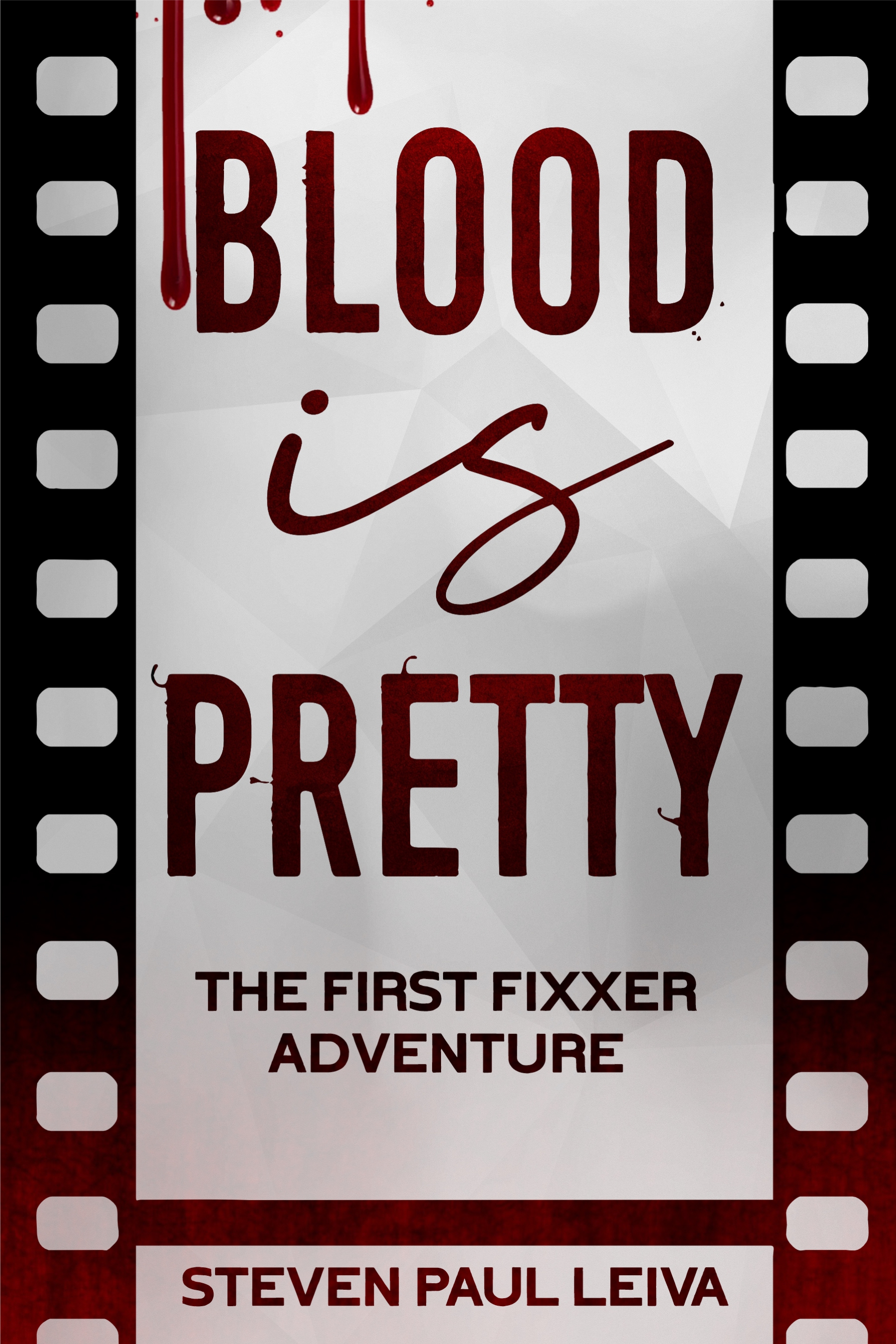


I wrote the novel in the mid-1990s after experiencing several painful “disappointments” in my Hollywood career. Disappointments in events and in people. Disappointments are not rare in Hollywood. And yet, when it is your disappointments, they seem far more intensely essential and worthy of revenge. 


I had intended for Blood is Pretty just to be a page-turning thriller inspired by such books from the past, including Ian Fleming’s James Bond novels, Sapper’s Bulldog Drummond books, and Leslie Charteris’ The Saint tomes. 


Fun to write, I assumed, and fun to read, I knew. But as it is not so much “write what you know” as it is, “what else can you really write but what you know?” the setting became Hollywood. And, since I had been a satirist since my college newspaper column writing days, I naturally took an askew (or screwy) view of the place and cast the book with people from my Hollywood past that I had found to be, shall we say, less than lovable.


So, I wrote a satiric Hollywood thriller—if you can imagine such a thing. But you don’t have to because I already did, and you can get it on Amazon as an eBook, trade paperback, or audiobook.


Did I have fun dispatching some of those less-than-lovely people? You damn right, I did. One was young and not yet famous but was convinced he would be before too long. And, indeed, he did become famous. One was an active director of mediocre movies who was self-deluded into thinking that all his films were fabulous. Another was a Hollywood hanger-on, a particularly obnoxious film reviewer for complimentary newspapers. And finally, there was a prominent studio executive whom I knew solely through press accounts in the Trades. But I did have a meeting with him shortly after Blood is Pretty was written. Irony—it's my life!


But lest you think Blood is Pretty is just an exercise in vindictive jollies, let me assure you I am not so one-dimensional and have a broader “what else can you really write but what you know?” field of dreams.


During this time, I read a lot about the brain and the scientific search for how it works. I have always been fascinated by how easily the brain is fooled. By dreams, by shadows, by shapes we perceive which aren't truly there. And, especially by our reactions to movies, how we can suspend disbelief and live comfortably in a manufactured reality. So I read books by Francis Crick, Paul M. Churchland, and Daniel C. Dennett and had the brain and its workings very much on my mind when I started writing Blood is Pretty.


This led me to create a McGuffin for my thriller called Veritas. This computer program can fool your brain far more powerfully than any virtual reality existing at the time and, indeed, even today. But it was also more than a McGuffin, for its existence in the story let me explore the gullible nature of the brain and how Hollywood exploits that.


The following paragraph is on the acknowledgments page of Blood is Pretty.


There is a particular theory of consciousness—of how the brain gives us reality—which I have used as a basis for a significant element in this novel. As reported in the New York Times, the theory’s strongest proponent is Dr. Rodolfo Llinás, a professor of neuroscience at New York University. I am indebted to him and the excellent New York Times science reporting for the inspiration. However, the technological extrapolation I spin-off this theory comes solely from the reality of my brain, and neither Dr. Llinás nor the New York Times should be held accountable for it.


Despite this modicum of serious intent in Blood is Pretty, readers have found the book fun, entertaining, and—I say with a modicum of humility—a good read. Now that I have re-proofed and polished the original book, I believe the new, revised edition is an even better "good read" than before.


XX


BLOOD IS PRETTY

THE FIRST FIXXER ADVENTURE


It's the late 1990s—and Hollywood wants to take over the world!


What those in the know in Hollywood really know is that if they need a dark deed done, if they need a sticky personal or professional problem "fixed," they can call upon the mysterious and dangerous Fixxer. With wit and aplomb, he works the fruitful fields of Hollywood, fixing the sins and correcting the stupidities of the denizens therein. 


In Blood is Pretty, The Fixxer comes to the rescue of “the most beautiful woman I have ever seen” to extricate her from the grip of the soul-sucking sexual desires of a producer born in slime and takes on the task of buying off with money and muscle a film geek who won’t cooperate with a director of minuscule talent who simply wants to claim “V”—the geek’s “Holy Grail” of a film treatment—as his own. When the film geek is discovered dismembered, the Fixxer is compelled to know why and finds worlds of evil, both real and virtual, centering around a computer program called Veritas, which has the potential of making its owner the wealthiest and most powerful human on Earth. With the aid of Roee, his friend, companion, and cook who can kill quickly and silently in several different ways; the Captain, officially with the Los Angeles Police Department, unofficially with the Fixxer; Petey, extraordinarily brilliant and comically strange; and “the most beautiful woman I have ever seen,” the Fixxer goes forth to do battle. 


Blood is Pretty: The First Fixxer Adventure (Revised Edition) from Magpie Press is now available in trade paperback and eBook formats on Amazon. You can also get the Crossroad Press audiobook edition on Amazon and Audible.


Cheers to all!


xx


Wednesday, August 5, 2020

WITH BRADBURY BEYOND APOLLO A CLEAR-EYED AND PENETRATING BIO IS CONCLUDED


With the publication of Bradbury Beyond Apollo (University of Illinois Press), Jonathan R. Eller has completed his three-volume self-designated “biography of a mind” of the author of Fahrenheit 451, The Martian Chronicles, Something Wicked This Way Comes, Dandelion Wine, and hundreds of published short stories. Eller began with Becoming Ray Bradbury in 2011, followed that up with Ray Bradbury Unbound in 2014, and it has been six long years for this conclusion to reach us. Although the book’s publication date of August 22, 2020, the centenary of Bradbury’s birth, is so appropriate, it is easy to forgive Eller. 


The obvious question then is, was it worth the wait? I suppose each reader must answer that for themselves, but it was for me. I greatly admired the first volume for Eller’s insight into Bradbury’s early years and his growth as an artist of narrative prose, the experiences, influences, loves, needs, relationships, fears, and passions that shaped and matured the mind giving birth to Bradbury’s unique creativity. In the second volume Eller detailed Bradbury’s creative world widening out to include film, theater, fine art and architecture, and the future of space exploration by man and machine. Eller’s documenting these activities, what they meant to Bradbury and how they affected him, confirmed a suspicion I have always held that Bradbury’s love and involvement in these areas might have diminished his time, energy, and efforts in practicing his true art of narrative prose. Bradbury Beyond Apollo continues from the second volume beginning after the first manned moon landing in 1969. Eller goes on to cover Bradbury’s essential—and valued—participation in what Eller calls “The Great Tale of space exploration.” Not as a scientist or engineer, of course, but as a visionary. The book concludes with Bradbury’s death in 2012 at ninety-one, more than a decade after a debilitating stroke, and some severe, if not total, loss of hearing and vision. It also chronicles Bradbury’s writing life as one of, again, eschewing a full concentration on new prose works for efforts to see his work metamorphosed into films, plays, and large scale theme-park-like presentations. Many of these efforts were unfulfilled or unsatisfactory. 


I have a particular affection for this third volume, as it includes the years I knew Bradbury as a colleague and friend from 1977 to the end of his life. Indeed, I come in as a minor character in Bradbury’s story when Eller writes about our work together on a film project (unfulfilled and unsatisfactory for us both) in 1982-83. And my organizing of a series of city-wide events celebrating Bradbury’s 90th birthday in 2010, Ray Bradbury Week in Los Angeles. But affection is not assessment, and in assessing this volume, I was struck not only by Eller’s compassionate if still objective eye on Bradbury but by just how fine a writer Eller is himself.


Despite Eller being an academic, despite being Chancellor's Professor of English; Director, Center for Ray Bradbury Studies; Senior Textual Editor, Institute for American Thought; General Editor, Collected Stories of Ray Bradbury; General Editor, The New Ray Bradbury Review; and ConsultingTextual Editor, Works of George Santayana (whew!) at Indiana University School of Liberal Arts—and despite a university press publishing the three volumes—none of the three read like academic texts. Nor do they read like a “popular biography” which might concentrate more on Bradbury the flesh and blood man, giving an exterior view of his activities both literary and personal. Rather, as I mentioned above, Eller writes with compassion in clear and often engrossing prose of the interior, creative mind of Bradbury, tracking him, in the three volumes, from young enthusiast for things of wonder—Mars, space adventures, literary treasures in a library, movies, music, and the spires of futuristic cities depicted in sci-fi illustrations—to his late in life energetic fashioning of new story collections combining stories past and recent, and the writing of possibly a new sub-genre: three autobiographical mystery novels exploring his early writing life. 


Why a compassionate eye? Because Eller has a deep understanding of the artist that Bradbury’s mind shaped, an artist with the inability to follow the standard, the form, the pattern, the rules, and the expected from the only venues for his writing early on—pulp magazines. (Or the integrity not to, assuming there is a difference). This led to a lifetime of creating unique works of prose poetry, using words like a sculptor might use clay to shape into stories what his imaginative instincts improvised. And, later, his ventures into the non-prose form of dramatic writing for both film and stage using this same method. This invariably led to conflicts with magazine editors, film, television, and theater producers and directors, and other collaborators necessary to take his work from his mind to some tangible form. The more distant from the prose Bradbury authored alone, the more authority the collaborators had, and the more frustrating, possibly infuriating, it could be for Bradbury when they were not—so to speak—on the same page with him. It is in the telling of these collaborations and Bradbury’s disappointments that Eller writes with compassion.


Is compassion warranted? After all, didn’t Bradbury know the job(s) was dangerous when he took it? He certainly didn’t when, in 1953, he took the Moby Dick screenwriting assignment from director John Huston, who he hero-worshiped. But shouldn’t the following six decades of many experiences in collaboration—starting with Huston’s bully tactics—have, “wised him up”?  Possibly. But Bradbury, as an artist, did not operate from mature wisdom, but from youthful, passionate loves. 


Eller writes, “In his mind it all came down to love, really; Bradbury paid the price of fame as all writers of magnitude must, but the effects were tempered by the simple admonition of literary love, a love that did not distinguish between the popular and the literary: ‘So I always wanted to be on the shelves, with my loves,’ he would later reflect in private conversation. ‘That’s different than being famous, isn’t it? I wanted to share the library dark with them. I wanted to go look up on the shelf and see the titles with their golden eyes—the numerals, the golden numerals, spelling my name with theirs. But that’s not fame, that’s love.’”


If Bradbury’s love had stayed with just the literary, he would have saved himself a lot of pain and frustration. But his capacity for passion was too big for just one manifestation of creativity. And so, just as he wanted to share library shelf space with writers he admired—from Verne, Wells, and Burroughs to Wolfe, Hemingway, and Fritzgerald—when given the opportunity he naturally wanted to share creative space with actors, filmmakers, musicians, fine artists and illustrators, architects, and even the space explorers he admired. And I’m sure he was pleased when they were pleased to share that space with him. Don’t we all want to be admired by people we admire?


Because of his own unique genius as a writer, easily recognized by other creative artists, Bradbury was able to share creative and intellectual space with the likes of, in alphabetical order, Buzz Aldrin, Bernard Berenson, George Cukor, Walt Disney, Kirk Douglas, Jose Feliciano, Federico Fellini, Mel Gibson, Jerry Goldsmith, Kathrine Hepburn, Charlton Heston, Alfred Hitchcock, Gene Kelly, Charles Laughton, Joe Mantegna, Jason Robards, Carl Sagan, Lalo Schifrin, and Orson Welles, among others. 


If Bradbury had not been consumed with these other passions and loves, what other fine works of narrative prose might he have written? Would there have been hundreds of more short stories? Would this master of the short story have conquered the long narrative form of the novel, which is almost universally acknowledged as not his strongest art? (And yet Fahrenheit 451 is one of the most read and influential novels of the 20th-Century). Who knows? Possibly Bradbury had said all he really wanted to say in prose, published and unpublished, by 1970. Possibly taking this output and adapting them to other forms he loved was what was going to fuel his creative fires from that point onward. But that meant collaborating, taking on creative partners. The thing about prose artists—not just workers in the field, but artists—is that, except in very rare instances, it is a lonely, individual art form. Such an artist is the sole author, thus the authority, and anyone who is truly good at it usually is most comfortable being rather autocratic in that authority. 


It is not that Bradbury didn’t want to collaborate, it just was not, I believe, a natural fit for him, as much as he might have wanted it to be. Given that, his frustrations are understandable. Certainly, Eller understands them and rightly conveys his compassion for the man. Not that there weren’t some rewarding collaborations, such as The Ray Bradbury Theater on cable. But these were ones where Bradbury retained a large measure of the authority. 


Eller also understands that for a man like Bradbury, a man of passions and loves, despite the frustrations, great joy can be experienced in pursuing them. Anyone who knew Bradbury knows he was a man of great joy. Anyone who saw him lecture knew he could effortlessly communicate, even transfer that joy to the audience, big or small—truly his most successful art after narrative prose—which must have heightened Bradbury’s own joy.


So as much as I and Bradbury’s legion of devoted readers of his stories and novels would have liked much more, who the hell would have wanted to deny Ray Bradbury his joys? 


Eller’s achievement in Bradbury Beyond Apollo and his two previous volumes will stand for years as the most penetrating view into the creative fire that was Bradbury’s mind and talent. It is a work of clear-eyed scholarship and, it must be said, love. In writing about a man and artist for whom love was all-important, how could one successfully do so otherwise?


Bradbury Beyond Apollo and the first two volumes can be purchased on Amazon and other online bookstores in both print and digital formats.


You will find Eller’s Amazon Author’s Page HERE


You can read my 2011 review of Becoming Ray Bradbury HERE.

You can read my 2014 review of Ray Bradbury Unbound HERE.

You can check out my novels on the MY BOOKS page of this blog, as well as my book of essays, Searching for Ray Bradbury: Writings about the Writer and the Man. 


Wednesday, February 12, 2020

A CONNECTION WITH RAY BRADBURY I NEVER KNEW I HAD


Most of my friends and some of my readers know that the writings of Ray Bradbury were an early influence on me as a writer; that the man Ray Bradbury became a colleague in the film industry; that the author Ray Bradbury was wonderfully generous toward me—and a plethora of other writers—and that during his 90th year I was able to arrange a week-long series of events in Los Angeles to honor him during his birthday week.


All of which I, of course, hold dear. But now, in Ray’s 100th year, I have discovered a connection with Ray that I was never aware of, and couldn’t even have imagined.

That discovery is due to the scholarship of Jonathan R. Eller, Chancellor's Professor of English and Director of the Center for Ray Bradbury Studies at the Indiana University School of Liberal Arts. 

Jon is also the author of the best biography of Ray that I know of. In three volumes—Becoming Ray Bradbury, Ray Bradbury Unbound, and to be released later this year, Bradbury Beyond Apollo—Jon has written, as he calls it, “a biography of the mind.” It is certainly not a misnomer. Jon gets to the essence of Ray as a creative mind producing unique prose fiction of a high order. If you want to understand Bradbury the author you must read these books.


But let us get to the discovery. Recently, in preparing to be on the SOMETHING WONDERFUL THIS WAY CAME: 100 YEARS OF RAY BRADBURY panel at the 53rd California International Antiquarian Book Fair in Pasadena I contacted Jon for some information on Ray’s feeling about the “science fiction writer” label he lived with, not always happily so. Jon got back to me and told me a story that will be in Bradbury Beyond Apollo about a short poem Ray wrote in 1971 that gave some indication of what writer designation Ray preferred. At least at that moment. 

I won’t tell you that whole story, as I encourage you all to read it when Bradbury Beyond Apollo is published. But I do want to mention the details that were pertinent to my discovery. 

In 1971 Ray had a speaking engagement at Citrus College in Glendora, California. Although at the time it was considered to be in Azusa-Glendora as it sat between those two cities.

The night before the engagement Ray wrote the short poem mentioned above, which I think we can assume he read to the audience during his speech as it was later published in the June 4, 1971 issue of the Citrus College Clarion

Those are the bare facts. But what’s the connection to me?

I grew up in Azusa. I attended Citrus College, graduating in early 1970.

I wrote a weekly column for the Citrus College Clarion.

The place that I’m pretty sure Ray would have spoken at on campus was the recently built performing arts center, now known as the Haugh Performing Arts Center.


I was at the groundbreaking for that performing arts center a few years before.

While I was at the groundbreaking for the performing arts center a mob of students was at the firepit in front of the student center putting to the flame stacks of that day’s issue of the Citrus College Clarion.

The mob of students was burning stacks of that day’s issue of the Citrus College Clarion because of a column I wrote.

It was a column of satire purporting to be the verbatim account of a meeting of the White Backlashers Union in which the members discussed ways to take care of the “blacks” problem in America. What they came up with were not, shall we say, nice ways. I was, of course, mocking crude, ignorant, hateful racism.

It was not the first time irony had been misunderstood (right, Dean Swift?). 

The students, especially those in the Black Students Union, several of whom were my friends, took the piece a bit too literally, assuming I was putting out serious solutions to something I did not see as a problem at all.
Part of the misunderstanding may have come not so much from my writing as from the headline to the column which was, I believe, THE WBU, THE BSU, YOU AND I. I did not write the headline, as no journalist does. And I did not mention the Black Students Union (BSU) in the piece.

Nevertheless, despite offense not intended; offense was taken, mob psychology took over, and my words on paper suffered the fate of being exposed to 451 degrees Fahrenheit.


I was gobsmacked (lovely word, that) when I learned all this just a week or so ago.

I now feel a wholly different kind of connection with Ray. A connection I’m not sure I can put into words. Which is ironic on several levels.

But I can feel it. 

And feel it I do. Deeply.

================================================

You can check out and purchase Jon Ellers’s books on Ray Bradbury on Amazon.

You might also want to check out the Center for Ray Bradbury Studies and the wonderful being done there under Jon’s leadership.

You can take a gander at my novels on the MY BOOKS page on this blog or on my Author’s Page on Amazon where you can also, of course, purchase.

And may I also recommend my short book of essays, Searching for Ray Bradbury: Writings about the Writer and the Man.