While visiting Ray Bradbury in his home one day, he turned to me and asked, “Do you know what the great thing is about writing fiction?”
 |
| Ray Bradbury at home |
“You get to kill your enemies!”
We shared a laugh over that because it can be so true.
Ray famously dispatched film director John Huston in his short story “Banshee.” Before he knew him, Huston had been one of Ray’s heroes. But when Ray worked with Huston on Moby Dick, writing the screenplay in Ireland, where Huston lived, Ray found him to be a merciless bully.
 |
| John Huston and Ray Bradbury working on Moby Dick |
It was a trying and possibly traumatic time for Ray. Which must have sat in his mind waiting for some kind of exorcism. Possibly it came when, years later, Ray wrote his short story "Banshee."
In “Banshee,” Huston becomes film director “John Hampton,” and Ray, whose middle name was Douglas, becomes young screenwriter “Douglas Rogers.”
 |
| Charles Martin Smith as "Douglas Rogers" and Peter O'Toole as "John Hampton" in the Ray Bradbury Theater presentation of Banshee |
It is blatantly autobiographical—except for the Banshee, of course, which is portrayed as an actual entity, and, horrifyingly, snatches Hampton off into eternity.
Despite taking place in Ireland, “Banshee,” and Ray’s experience that gave birth to it, is a Hollywood story. It’s a wonder that Ray still pursued an association with “The Biz” after Ireland and the great white whale of Huston’s ego, but he did. Ray was a giddy cinephile. And, to be fair, he made many friends in Hollywood whom he admired and who admired him in return.
But it’s one's enemies who often provide the fodder for fiction.
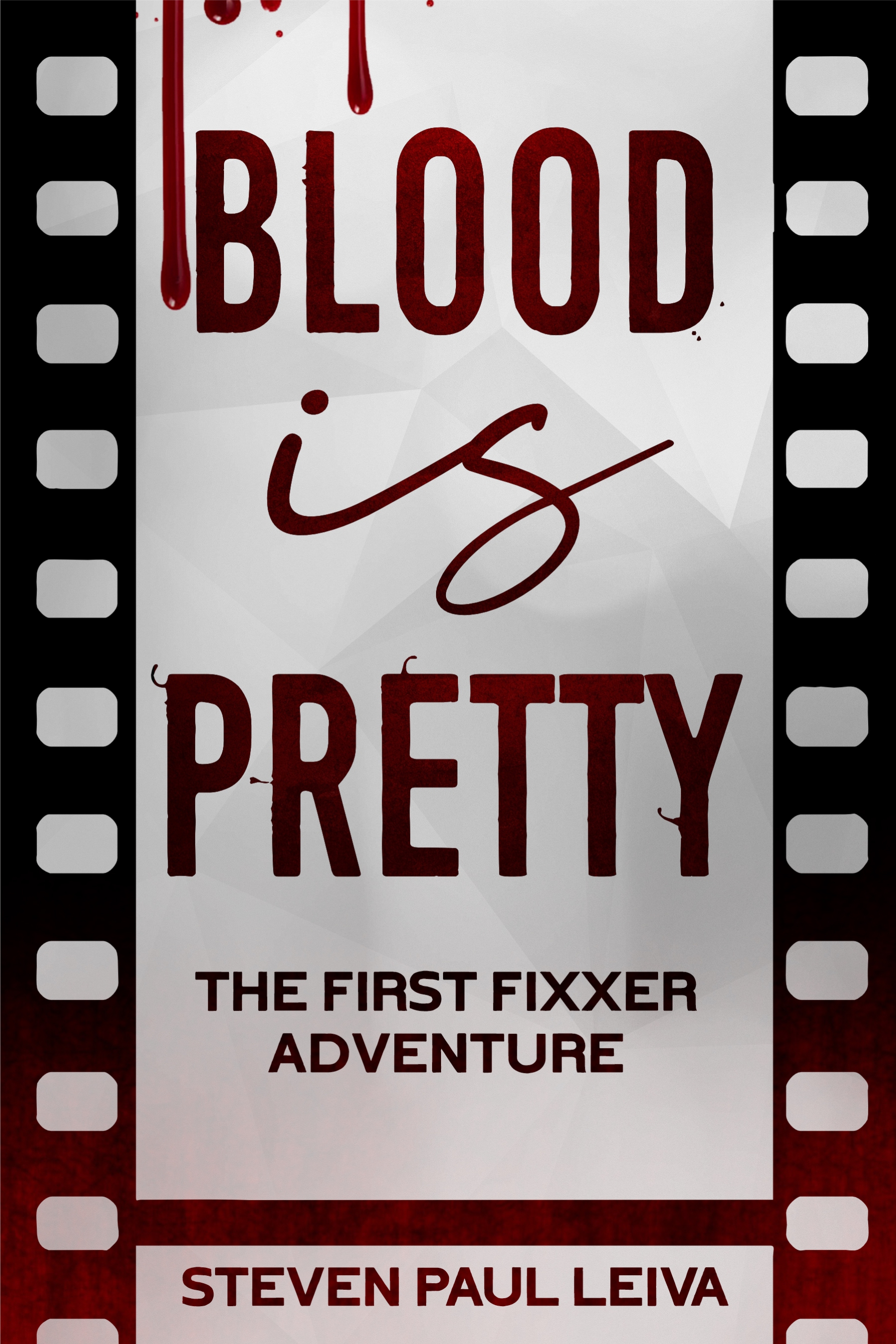
I discovered this while writing my critically acclaimed novel Blood is Pretty: The First Fixxer Adventure, which I have just re-published in a revised edition under my Magpie Press imprint.
I wrote the novel in the mid-1990s after experiencing several painful “disappointments” in my Hollywood career. Disappointments in events and in people. Disappointments are not rare in Hollywood. And yet, when it is your disappointments, they seem far more intensely essential and worthy of revenge.
I had intended for Blood is Pretty just to be a page-turning thriller inspired by such books from the past, including Ian Fleming’s James Bond novels, Sapper’s Bulldog Drummond books, and Leslie Charteris’ The Saint tomes.

Fun to write, I assumed, and fun to read, I knew. But as it is not so much “write what you know” as it is, “what else can you really write but what you know?” the setting became Hollywood. And, since I had been a satirist since my college newspaper column writing days, I naturally took an askew (or screwy) view of the place and cast the book with people from my Hollywood past that I had found to be, shall we say, less than lovable.
So, I wrote a satiric Hollywood thriller—if you can imagine such a thing. But you don’t have to because I already did, and you can get it on Amazon as an eBook, trade paperback, or audiobook.
Did I have fun dispatching some of those less-than-lovely people? You damn right, I did. One was young and not yet famous but was convinced he would be before too long. And, indeed, he did become famous. One was an active director of mediocre movies who was self-deluded into thinking that all his films were fabulous. Another was a Hollywood hanger-on, a particularly obnoxious film reviewer for complimentary newspapers. And finally, there was a prominent studio executive whom I knew solely through press accounts in the Trades. But I did have a meeting with him shortly after Blood is Pretty was written. Irony—it's my life!
But lest you think Blood is Pretty is just an exercise in vindictive jollies, let me assure you I am not so one-dimensional and have a broader “what else can you really write but what you know?” field of dreams.
During this time, I read a lot about the brain and the scientific search for how it works. I have always been fascinated by how easily the brain is fooled. By dreams, by shadows, by shapes we perceive which aren't truly there. And, especially by our reactions to movies, how we can suspend disbelief and live comfortably in a manufactured reality. So I read books by Francis Crick, Paul M. Churchland, and Daniel C. Dennett and had the brain and its workings very much on my mind when I started writing Blood is Pretty.

This led me to create a McGuffin for my thriller called Veritas. This computer program can fool your brain far more powerfully than any virtual reality existing at the time and, indeed, even today. But it was also more than a McGuffin, for its existence in the story let me explore the gullible nature of the brain and how Hollywood exploits that.
The following paragraph is on the acknowledgments page of Blood is Pretty.
There is a particular theory of consciousness—of how the brain gives us reality—which I have used as a basis for a significant element in this novel. As reported in the New York Times, the theory’s strongest proponent is Dr. Rodolfo Llinás, a professor of neuroscience at New York University. I am indebted to him and the excellent New York Times science reporting for the inspiration. However, the technological extrapolation I spin-off this theory comes solely from the reality of my brain, and neither Dr. Llinás nor the New York Times should be held accountable for it.
Despite this modicum of serious intent in Blood is Pretty, readers have found the book fun, entertaining, and—I say with a modicum of humility—a good read. Now that I have re-proofed and polished the original book, I believe the new, revised edition is an even better "good read" than before.
XX
BLOOD IS PRETTY
THE FIRST FIXXER ADVENTURE
It's the late 1990s—and Hollywood wants to take over the world!
What those in the know in Hollywood really know is that if they need a dark deed done, if they need a sticky personal or professional problem "fixed," they can call upon the mysterious and dangerous Fixxer. With wit and aplomb, he works the fruitful fields of Hollywood, fixing the sins and correcting the stupidities of the denizens therein.
In Blood is Pretty, The Fixxer comes to the rescue of “the most beautiful woman I have ever seen” to extricate her from the grip of the soul-sucking sexual desires of a producer born in slime and takes on the task of buying off with money and muscle a film geek who won’t cooperate with a director of minuscule talent who simply wants to claim “V”—the geek’s “Holy Grail” of a film treatment—as his own. When the film geek is discovered dismembered, the Fixxer is compelled to know why and finds worlds of evil, both real and virtual, centering around a computer program called Veritas, which has the potential of making its owner the wealthiest and most powerful human on Earth. With the aid of Roee, his friend, companion, and cook who can kill quickly and silently in several different ways; the Captain, officially with the Los Angeles Police Department, unofficially with the Fixxer; Petey, extraordinarily brilliant and comically strange; and “the most beautiful woman I have ever seen,” the Fixxer goes forth to do battle.
Blood is Pretty: The First Fixxer Adventure (Revised Edition) from Magpie Press is now available in trade paperback and eBook formats on Amazon. You can also get the Crossroad Press audiobook edition on Amazon and Audible.
Cheers to all!
xx