Showing posts with label satire. Show all posts

Thursday, May 18, 2023

DISPATCHING YOUR ENEMIES


While visiting Ray Bradbury in his home one day, he turned to me and asked, “Do you know what the great thing is about writing fiction?”


Ray Bradbury at home
“What?” I queried back.

“You get to kill your enemies!”

We shared a laugh over that because it can be so true.


Ray famously dispatched film director John Huston in his short story “Banshee.” Before he knew him, Huston had been one of Ray’s heroes. But when Ray worked with Huston on Moby Dick, writing the screenplay in Ireland, where Huston lived, Ray found him to be a merciless bully. 


John Huston and Ray Bradbury working on Moby Dick


It was a trying and possibly traumatic time for Ray. Which must have sat in his mind waiting for some kind of exorcism. Possibly it came when, years later, Ray wrote his short story "Banshee."


In “Banshee,” Huston becomes film director “John Hampton,” and Ray, whose middle name was Douglas, becomes young screenwriter “Douglas Rogers.” 


Charles Martin Smith as "Douglas Rogers"
and Peter O'Toole as "John Hampton"
in the Ray Bradbury Theater presentation of Banshee

It is blatantly autobiographical—except for the Banshee, of course, which is portrayed as an actual entity, and, horrifyingly, snatches Hampton off into eternity. 


Despite taking place in Ireland, “Banshee,” and Ray’s experience that gave birth to it, is a Hollywood story. It’s a wonder that Ray still pursued an association with “The Biz” after Ireland and the great white whale of Huston’s ego, but he did. Ray was a giddy cinephile. And, to be fair, he made many friends in Hollywood whom he admired and who admired him in return.


But it’s one's enemies who often provide the fodder for fiction.


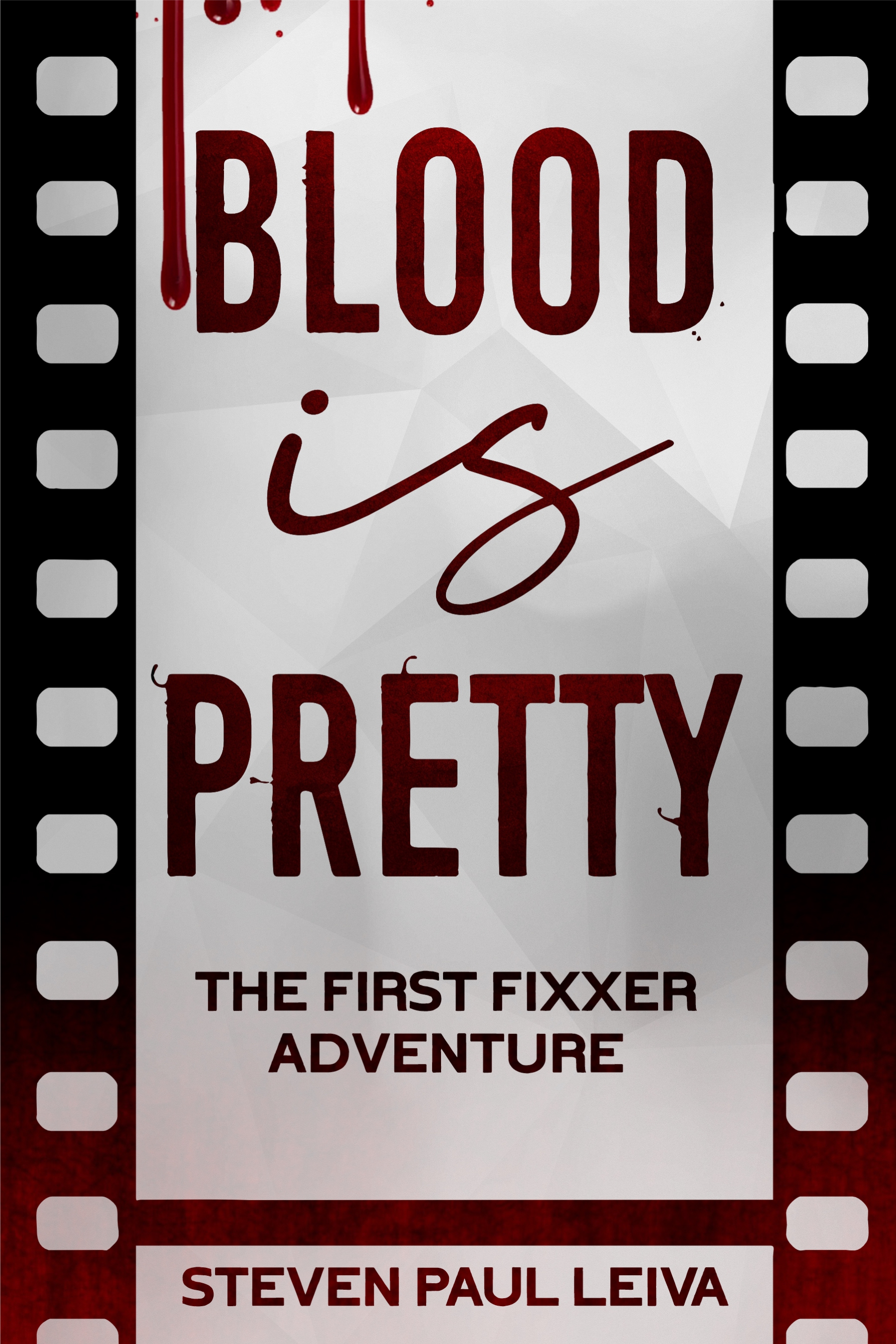
I discovered this while writing my critically acclaimed novel Blood is Pretty: The First Fixxer Adventure, which I have just re-published in a revised edition under my Magpie Press imprint. 


I wrote the novel in the mid-1990s after experiencing several painful “disappointments” in my Hollywood career. Disappointments in events and in people. Disappointments are not rare in Hollywood. And yet, when it is your disappointments, they seem far more intensely essential and worthy of revenge. 


I had intended for Blood is Pretty just to be a page-turning thriller inspired by such books from the past, including Ian Fleming’s James Bond novels, Sapper’s Bulldog Drummond books, and Leslie Charteris’ The Saint tomes. 


Fun to write, I assumed, and fun to read, I knew. But as it is not so much “write what you know” as it is, “what else can you really write but what you know?” the setting became Hollywood. And, since I had been a satirist since my college newspaper column writing days, I naturally took an askew (or screwy) view of the place and cast the book with people from my Hollywood past that I had found to be, shall we say, less than lovable.


So, I wrote a satiric Hollywood thriller—if you can imagine such a thing. But you don’t have to because I already did, and you can get it on Amazon as an eBook, trade paperback, or audiobook.


Did I have fun dispatching some of those less-than-lovely people? You damn right, I did. One was young and not yet famous but was convinced he would be before too long. And, indeed, he did become famous. One was an active director of mediocre movies who was self-deluded into thinking that all his films were fabulous. Another was a Hollywood hanger-on, a particularly obnoxious film reviewer for complimentary newspapers. And finally, there was a prominent studio executive whom I knew solely through press accounts in the Trades. But I did have a meeting with him shortly after Blood is Pretty was written. Irony—it's my life!


But lest you think Blood is Pretty is just an exercise in vindictive jollies, let me assure you I am not so one-dimensional and have a broader “what else can you really write but what you know?” field of dreams.


During this time, I read a lot about the brain and the scientific search for how it works. I have always been fascinated by how easily the brain is fooled. By dreams, by shadows, by shapes we perceive which aren't truly there. And, especially by our reactions to movies, how we can suspend disbelief and live comfortably in a manufactured reality. So I read books by Francis Crick, Paul M. Churchland, and Daniel C. Dennett and had the brain and its workings very much on my mind when I started writing Blood is Pretty.


This led me to create a McGuffin for my thriller called Veritas. This computer program can fool your brain far more powerfully than any virtual reality existing at the time and, indeed, even today. But it was also more than a McGuffin, for its existence in the story let me explore the gullible nature of the brain and how Hollywood exploits that.


The following paragraph is on the acknowledgments page of Blood is Pretty.


There is a particular theory of consciousness—of how the brain gives us reality—which I have used as a basis for a significant element in this novel. As reported in the New York Times, the theory’s strongest proponent is Dr. Rodolfo Llinás, a professor of neuroscience at New York University. I am indebted to him and the excellent New York Times science reporting for the inspiration. However, the technological extrapolation I spin-off this theory comes solely from the reality of my brain, and neither Dr. Llinás nor the New York Times should be held accountable for it.


Despite this modicum of serious intent in Blood is Pretty, readers have found the book fun, entertaining, and—I say with a modicum of humility—a good read. Now that I have re-proofed and polished the original book, I believe the new, revised edition is an even better "good read" than before.


XX


BLOOD IS PRETTY

THE FIRST FIXXER ADVENTURE


It's the late 1990s—and Hollywood wants to take over the world!


What those in the know in Hollywood really know is that if they need a dark deed done, if they need a sticky personal or professional problem "fixed," they can call upon the mysterious and dangerous Fixxer. With wit and aplomb, he works the fruitful fields of Hollywood, fixing the sins and correcting the stupidities of the denizens therein. 


In Blood is Pretty, The Fixxer comes to the rescue of “the most beautiful woman I have ever seen” to extricate her from the grip of the soul-sucking sexual desires of a producer born in slime and takes on the task of buying off with money and muscle a film geek who won’t cooperate with a director of minuscule talent who simply wants to claim “V”—the geek’s “Holy Grail” of a film treatment—as his own. When the film geek is discovered dismembered, the Fixxer is compelled to know why and finds worlds of evil, both real and virtual, centering around a computer program called Veritas, which has the potential of making its owner the wealthiest and most powerful human on Earth. With the aid of Roee, his friend, companion, and cook who can kill quickly and silently in several different ways; the Captain, officially with the Los Angeles Police Department, unofficially with the Fixxer; Petey, extraordinarily brilliant and comically strange; and “the most beautiful woman I have ever seen,” the Fixxer goes forth to do battle. 


Blood is Pretty: The First Fixxer Adventure (Revised Edition) from Magpie Press is now available in trade paperback and eBook formats on Amazon. You can also get the Crossroad Press audiobook edition on Amazon and Audible.


Cheers to all!


xx


Saturday, February 16, 2013

GIVE STEVEN PAUL LEIVA A GOOD SWIFT KICK IN HIS BOOKS WEEK


You’ve all heard of Kickstarter. This is where people with admirable projects -- a film, a new organic baby food, a portrait of President Obama created using only thumbtacks and used contact lenses -- and who need a little financial kick to get going, put their proposal online and ask friends and relatives and relative strangers to send them anywhere from a dollar or two or ten, to thousands of the digital greenbacks. And what do people get for doing so? Well, depending on the level of your contribution, you might get a “shout out” on a Facebook page, your name on the wall of a micro brewery, two tickets to a film yet to be made and maybe a character named after you, or the actual product (a neat tee shirt?) when it is finished. Kickstarter has become quite popular and newsworthy, and now it seems that everybody is doing it.

I was musing on this the other day and it occurred to me that I, the author of novels, don’t really need a kickstart -- novels are not expensive products to create. And I’ve never really had a problem in starting (or finishing) them. But having three novels I’m very proud of available for sale in various formats (print; e-book; audiobook) at that great supermarket in the Cloud, Amazon, what I need is not a kickstart. I need a bloody kick forward. You might even say I need a good swift kick in the books.

Why? Because it would be great to get boku sales of my books in a concentrated period of time in order to send up a flag of triumph to Amazon thereby possibly spurring them on to feature and market my work, which would, it is hoped, lead to more sales. Wouldn’t that be lovely?

So I drop all pretensions to decorum and audaciously presume upon all your good natures to help.

I’ve decided to declare the week of February 17 to 23 GIVE STEVEN PAUL LEIVA A GOOD SWIFT KICK IN HIS BOOKS WEEK. If you want to help that week -- buy one (or more, he hastened to add) of my books.

And just what is that going to cost me, Leiva?

Well, my e-books are priced at $2.99 and $3.99 -- cheaper than a Latte at Starbucks.
I have one book at the moment in print (more to come), and it’s only $14.99 -- cheaper than red lobster at the Red Lobster. And my one audiobook is under 20 bucks -- cheaper than a new pair of jeans at a discount fashion store.

(You can check out all my books, read reviews from people of distinction and readers of taste, see videos and listen to an audiobook excerpt at my new MY BOOKS page on my blog http://stevenpaulleivasthisnthat.blogspot.com/p/my-books.html.)

And for your “donation” what do you get? Well -- you get one of my books!! Hey, it’s like old-fashion 20th Century commerce, you give me money I give you the product. It’s very simple. Not a lot of cool, post-modern bells and whistles, but what the hell?

But I don’t have a Kindle, Leiva.

No Problem. You can download Free Kindle Reading Apps at Amazon. With these apt apps you can read my books in the Amazon Cloud Reader, on your smartphone, computer or tablet.

But I don’t want to read your books, Leiva.

Fine, I’m not asking you to read them, just buy them. That’s what’s so audacious about this proposal. Just buy it, download it, then trash it if you wish. You won’t even be wasting paper. Just think of it as buying me a discounted Latte at Starbucks so we can sit down and snicker at all the wannabe screenwriters sweating over their laptops.

But -- should you choose to read one of my books I’m pretty confident you’ll enjoy it. Others have. My Hollywood friends would enjoy my Hollywood satiric thrillers, "Blood is Pretty" and "Hollywood is an All-Volunteer Army." Although my Hollywood enemies might not. For those of you not employed in Hollywood, don’t let that put you off. I know you know enough about Hollywood to get it. Plus, who doesn’t like thrills? As to my sci-fi satire, "Traveling in Space," a sometimes comic look at humankind’s place in the universe: Are you a human? Are you in the Universe? Enough said.

Or buy me the equivalent of a cheap dinner and purchase the print edition of "Traveling in Space." You’ll get to hold a “real” book in your hands and get high smelling the ink. Or the audiobook of "Blood is Pretty." Take it on a long drive. You’ll enjoy Jonah Cummings’ fine reading.

If you ever wanted to give me a good swift kick in the butt -- and I’m sure several of you have -- now you can do it metaphorically by giving my books a good swift kick forward. So run (with your key-clicking digits) don’t walk to the MY BOOKS section of my blog (http://stevenpaulleivasthisnthat.blogspot.com/p/my-books.html) and check out my books. Then click on the Amazon links provided and -- check out my books. You will get the deep satisfaction of helping an author under six foot, but who tries to stand tall nonetheless, you will get literary value for your dollar, and you will get my undying gratitude.

And if this decorum-less and audacious invasion into your consciousness works and my books do indeed get kicked forward, I will be happy to tell each and everyone of you individually that you -- and you alone -- made me the success I will be tomorrow.

P.S. And go ahead, forward this on to friends and family; share this on Facebook; put up a billboard in the town square. Just how many people will you really alienate?

GIVE STEVEN PAUL LEIVA A GOOD SWIFT KICK IN HIS BOOKS WEEK FEBRUARY 17 TO 23

Monday, November 14, 2011

RUSSELL BLACKFORD, gentleman, scholar, and philosopher, reviews TRAVELING IN SPACE


Australian philosopher and literary critic, Russell Blackford has posted a review of Traveling in Space on his very popular blog, Metamagician and the Hellfire Club.  


Russell is the editor-in-chief of The Journal of Evolution and Technology, an on-line, peer-reviewed journal, and Conjoint Lecturer in the School of Humanities and Social Science at the University of Newcastle. He is the co-editor of 50 Voices of Disbelief: Why We Are Atheists 


You can find his blog (always interesting!) here: http://metamagician3000.blogspot.com/  


SUNDAY, NOVEMBER 13, 2011

Currently reading - Traveling in Space

I've been reading Steven Paul Leiva's new novel, Traveling in Space - a book that I'm enjoying a lot. In form, it's a science fiction narrative, but not one that presents space-opera-style battles or one that aims at verisimilitude in the manner of hard sf.

Instead, we're given a satirical story in the tradition of books such as Robert A. Heinlein's Stranger in a Strange Land


with which it shares something of a common sensibility, or even Gulliver's Travels


Look for elements of Menippean satire, such as a fragmented narrative, philosophical debates, and pervasive mockery of both sacred and "commonsense" ideas.


Menippus, by Velázquez


Traveling in Space is sufficiently sprawling and complicated to require a list of dramatis personae to help sort out its characters: see here, on Steve Leiva's blog, where you can find out quite a bit more about the book and its author. 

The book's satirical force is generated by contact between two mutually- baffled intelligent species: a bunch of extraterrestrial aliens traveling in space far from their home world; and human beings here on Earth, whom they encounter and try to understand. This opens up all sorts of possibilities. The aliens are not bug-eyed monsters, but humanlike beings from a vastly older, technologically superior civilisation. They immediately strike Earth men and women as physically gorgeous and fascinating. For their own part, they find us equally fascinating ... though physically repulsive.

Many of the aliens' encounters with human beings are downright funny. They see the idiocy of many of our institutions and practices, whether it be religion, war, or prudishness about the body. As the narrative continues, however, and they are confronted by the facts of race hate and genocide, the satire takes on a different tone. The aliens still struggle to understand what they're seeing, but the denunciation grows more bitter (even when the horrors are filtered through the perceptions of the aliens, who examine human conduct in a rather clinical way).

All of this is familiar, of course - many authors have used contact with earthly or extraterrestrial aliens to satirise the ways of human beings - but Traveling in Space takes on an extra layer of complexity as the aliens themselves change, in one way or another, in response to their interactions with us ... and as some aspects of their civilisation are also shown to be corrupt, unjust, and unsavoury. If, as readers, we started out thinking that the aliens were a noble, uncorrupted people who make humans seem like yahoos by comparison, we soon learn that the situation is not at all so simple.

Both species have something to learn from contact with each other, as it turns out, and the most important learning takes place on the aliens' side. Complications such as these give us much to think about, and I'm sure that Traveling in Space will play on my mind for some time to come.